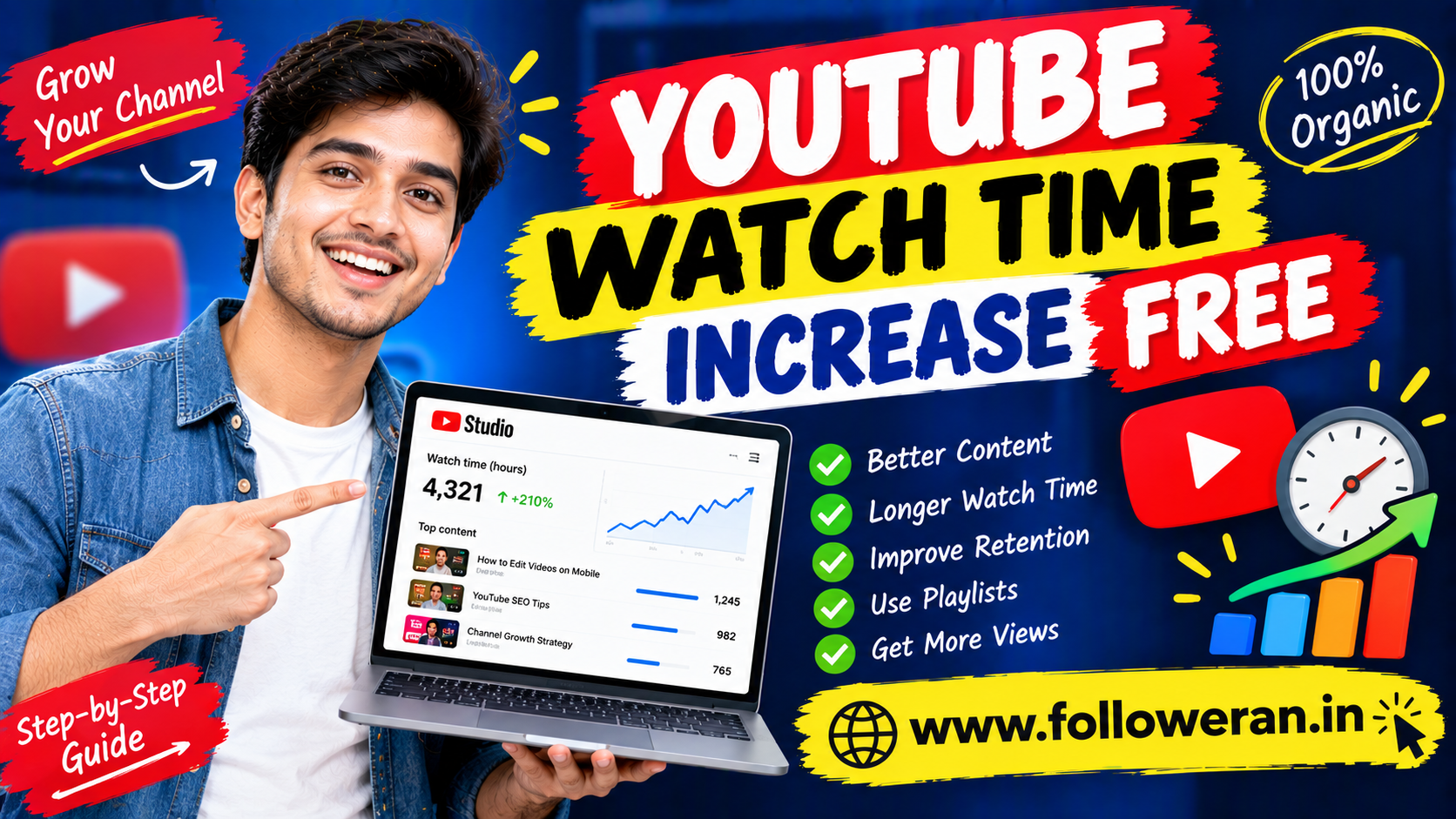
YouTube Watch Time Increase Free: How to Grow Watch Hours Organically
The search for “YouTube watch time increase free” is common among creators who want to increase their YouTube watch hours without buying watch time or spending money on advertising.
Watch time is one of the most useful metrics for understanding how much time people actually spend consuming your content. YouTube Analytics shows watch time in hours and provides related metrics such as average view duration and audience retention.
For creators working toward YouTube Partner Program eligibility, watch time is particularly important. As of September 2026, YouTube's published requirements for ad-revenue sharing include 1,000 subscribers plus either 4,000 qualified watch hours from public long-form videos during the previous 365 days or 10 million qualified public Shorts views during the previous 90 days. Watch hours from Shorts views in the Shorts Feed do not count toward the 4,000-hour threshold.
That makes it important to understand the difference between simply generating viewing activity and building qualified, legitimate watch time.
The good news is that you can increase watch time without paying for watch hours. The most sustainable approach is to create videos people genuinely want to watch and make it easy for them to continue watching.
What Does YouTube Watch Time Increase Free Mean?
The phrase YouTube watch time increase free generally refers to increasing the amount of legitimate time people spend watching your YouTube content without directly paying for watch hours.
People searching this keyword may be interested in:
Free YouTube watch time
Free YouTube watch hours
Increase watch time without paying
Reach 4,000 watch hours
YouTube watch time tools
Watch time generators
Organic YouTube growth
YouTube watch-hour strategies
These searches can represent very different methods.
Some focus on organic audience growth.
Others involve watch-time exchanges or third-party services.
For long-term channel development and monetization, it is important to distinguish real viewer activity from artificial or ineligible activity.
What Is YouTube Watch Time?
YouTube defines watch time as the amount of time viewers have watched your video content. YouTube Analytics includes watch time alongside metrics such as average view duration and audience retention.
For example, if:
100 viewers
each watch:
6 minutes
the total viewing time is approximately:
600 minutes
or:
10 hours
This simple calculation shows why longer videos can generate substantial watch time even without enormous view counts.
Why Is YouTube Watch Time Important?
Watch time helps you understand how much viewing activity your content creates.
A video with:
20,000 views
and:
1,000 watch hours
has generated a different result from a video with:
20,000 views
and:
150 watch hours
The view count is identical, but audience behavior is very different.
Watch time also matters for certain YouTube monetization thresholds. For the current YPP ad-revenue pathway, YouTube specifies 4,000 qualified watch hours from public long-form videos over the previous 365 days, together with 1,000 subscribers.
Can You Increase YouTube Watch Time for Free?
Yes.
You can increase legitimate watch time without purchasing it.
Effective methods include:
Creating longer useful videos
Improving audience retention
Making stronger openings
Building playlists
Linking related videos
Using end screens
Creating content series
Using YouTube Search
Publishing Shorts that lead viewers to longer videos
Hosting public live streams
Promoting videos to relevant audiences
Answering audience questions
The objective is to increase the amount of time real interested viewers spend with your content.
How YouTube Watch Time Is Different From Views
Views tell you about viewing activity.
Watch time tells you how much time viewers spent watching.
Imagine:
Video A
10,000 views
Average view duration: 30 seconds
Video B
5,000 views
Average view duration: 5 minutes
Video B has fewer views but can generate dramatically more watch time.
This is why creators should avoid optimizing for views alone.
How to Check Watch Time in YouTube Studio
You can monitor watch time through YouTube Studio.
A typical path is:
YouTube Studio
→ Analytics
→ Overview
YouTube's Analytics Overview reports key metrics such as views, watch time, subscribers, and estimated revenue where applicable.
For individual videos, you can also open the video's Analytics and review its engagement information, including watch time and audience retention.
How to Increase YouTube Watch Time Free
1. Create Longer Videos That Actually Deserve to Be Long
Long videos can generate more watch time, but length alone does not guarantee performance.
A useful:
15-minute tutorial
can outperform a poorly structured:
30-minute video
because people may actually continue watching the tutorial.
Do not add unnecessary content simply to increase duration.
2. Solve One Specific Problem
Problem-solving videos can keep viewers engaged because the audience has a clear reason to watch.
Examples:
How to Create YouTube Thumbnails
How to Edit YouTube Shorts
How to Start a YouTube Channel
How to Improve YouTube Watch Time
How to Use YouTube Studio
The viewer should understand what they will gain from watching.
3. Improve the First 30 Seconds
A viewer decides very quickly whether a video is worth continuing.
Avoid unnecessarily long introductions.
Instead:
State the problem
↓
Explain the result
↓
Start the solution
For example:
“In this video, I'll show you seven free methods to increase YouTube watch time and explain which metrics you should track.”
Then begin the first method.
4. Match the Video to the Title and Thumbnail
Your title and thumbnail create an expectation.
The video should deliver on that promise quickly.
If your thumbnail says:
INCREASE WATCH TIME
and the video spends the first two minutes discussing an unrelated topic, viewers may leave.
A strong match between:
Title
Thumbnail
Opening
Main content
helps create a more consistent viewing experience.
5. Improve Audience Retention
YouTube Analytics provides an audience-retention report that helps creators understand how well different parts of a video hold viewers' attention. YouTube also provides comparison functionality for recent videos of similar length.
Look for:
Large early drop-offs
Sections with strong retention
Moments where viewers leave
Moments where attention increases
Then use those findings when planning future videos.
6. Remove Unnecessary Introductions
Long introductions can waste the viewer's limited attention.
Instead of:
“Hello everyone, welcome back to my channel, today we're going to...”
consider beginning with:
“Here are five free ways to increase YouTube watch time.”
Then immediately deliver value.
7. Add a Strong Story Structure
Even educational videos can benefit from a clear structure.
Try:
Problem
↓
Why it matters
↓
Solution
↓
Example
↓
Result
↓
Next step
A structured video can feel easier to follow.
8. Create Content Series
Series encourage viewers to watch multiple videos.
For example:
YouTube Growth Part 1
YouTube Growth Part 2
YouTube Growth Part 3
YouTube Growth Part 4
A person who finishes Part 1 has a natural reason to continue.
9. Use Playlists
Group related videos into playlists.
For example:
YouTube Growth for Beginners
Channel Setup
Thumbnail Design
Video Titles
YouTube SEO
Watch Time
Audience Retention
Analytics
This makes the next relevant video easier to find.
10. Connect Related Videos
At appropriate moments, direct viewers to another relevant video.
For example:
“I explain thumbnails in detail in the next video.”
Then connect the viewer to that content.
The idea is to give them a useful next step rather than simply asking them to keep clicking.
11. Use End Screens
End screens can help viewers discover another relevant piece of content.
For example:
Current video: How to Increase YouTube Watch Time
Next video: How to Improve Audience Retention
This creates a logical viewing sequence.
12. Use Cards Where Relevant
Cards can connect related content during a video.
For example, if you mention:
“I made a full tutorial about YouTube thumbnails.”
you can point viewers toward that tutorial where appropriate.
Do not overload the viewer with unrelated links.
13. Make Better Thumbnails
A good thumbnail can help the right viewer recognize the value of the video.
Try:
One main idea
Large readable text
Clear subject
Strong visual hierarchy
Relevant imagery
Avoid clutter.
The goal is to attract the right viewer, not simply the highest possible number of clicks.
14. Write Better Titles
A title should communicate:
What the video is
Who it helps
Why it matters
Compare:
My YouTube Tips
with:
7 Free Ways to Increase YouTube Watch Time
The second title gives the audience a clearer reason to watch.
15. Use YouTube Search
Search-focused videos can generate long-term viewing.
Target questions such as:
How to increase YouTube watch time
How to edit YouTube videos on mobile
How to create YouTube Shorts
How to improve YouTube retention
How to start a YouTube channel
Create the video around the actual question.
16. Use Long-Tail Keywords
Broad topics are often highly competitive.
Instead of:
YouTube watch time
try:
How to increase YouTube watch time for a new channel
or:
How to get more watch hours on YouTube organically
Specific topics make it easier to satisfy a clear search intent.
17. Use Shorts as a Discovery Tool
Shorts can introduce people to your channel.
You can create:
Short: 3 YouTube retention mistakes
and then:
Long video: Complete YouTube Retention Guide
The Short acts as a discovery point while the longer video provides deeper information.
Remember that watch hours generated from Shorts views in the Shorts Feed do not count toward the 4,000 qualified watch-hour threshold for YPP ad-revenue eligibility. YouTube instead uses the separate qualified Shorts-view route for that pathway.
18. Turn Popular Shorts Into Long Videos
If a Short performs strongly, expand the subject.
For example:
Short: “3 Thumbnail Mistakes”
↓
Long video: “Complete YouTube Thumbnail Guide”
The long-form video can provide more depth while keeping the topic connected.
19. Create Public Live Streams
Live streams can generate substantial watch time when people genuinely watch the broadcast.
Ideas include:
Q&A
Tutorials
Interviews
Product demonstrations
Gaming
Live discussions
Educational sessions
For YPP qualification, YouTube distinguishes eligible public watch hours from watch activity associated with certain excluded video states and formats. Public long-form watch hours are the relevant category for the 4,000-hour pathway.
20. Turn One Video Into a Content Funnel
Suppose you create:
Video 1: YouTube Channel Setup
Then:
Video 2: YouTube Thumbnail Design
Then:
Video 3: YouTube SEO
Then:
Video 4: YouTube Watch Time
Then:
Video 5: YouTube Analytics
A viewer can naturally move from one topic to the next.
This creates more opportunities for longer sessions on your channel.
How to Increase Watch Time With Tutorials
Tutorials work particularly well when the viewer has a clear goal.
Use this structure:
What you'll learn
↓
Step 1
↓
Step 2
↓
Step 3
↓
Common mistakes
↓
Final result
You can also preview the final result at the beginning so viewers understand what they will achieve.
How to Increase Watch Time With Reviews
Reviews can be structured around:
Introduction
Main features
Advantages
Limitations
Real-world testing
Final assessment
Avoid stretching the review simply to make it longer.
How to Increase Watch Time With Educational Videos
Break complex subjects into chapters.
For example:
00:00 Introduction
01:00 What Watch Time Means
03:00 How YouTube Counts It
06:00 Improving Retention
10:00 Playlists
13:00 Analytics
This organization makes a longer video easier to follow.
How to Increase Watch Time With Storytelling
Stories can create curiosity.
A simple structure is:
Problem
↓
Challenge
↓
Attempt
↓
Unexpected result
↓
Lesson
This can work for:
Business stories
Travel videos
Personal experiences
Case studies
Experiments
Creator journeys
How to Increase Watch Time With Case Studies
Case studies can be particularly engaging when they show a clear transformation.
For example:
Starting point
What changed
What was tested
What happened
What was learned
The audience has a reason to stay until the conclusion.
Use Curiosity Without Clickbait
Curiosity can encourage continued viewing.
For example:
“I tested three thumbnail styles to see which one attracted more clicks.”
The viewer wants to see the result.
But the video should actually deliver the promised experiment.
Avoid misleading viewers simply to increase retention.
Give Viewers Progress Markers
Long videos can feel easier to watch when the audience knows where they are.
For example:
Step 1 of 5
Halfway Point
Final Strategy
This can make long tutorials feel more manageable.
Use Chapters for Long Videos
Chapters can make longer videos easier to navigate.
Example:
00:00 Start
01:15 Strategy 1
03:20 Strategy 2
06:00 Strategy 3
09:30 Analytics
This can improve usability without sacrificing the total length of the content.
Create Better Calls to Action
Do not interrupt the video every few minutes with:
“Like and subscribe.”
Instead, use a relevant CTA.
For example:
“If you're building a new channel, subscribe because the next video covers thumbnail testing.”
The request is connected to a future benefit.
Encourage Viewers to Continue
At the end of a video, avoid simply saying goodbye.
Instead:
“Now that you understand watch time, the next step is improving retention. Watch this related guide next.”
Then provide the relevant next-video path.
Build Topic Clusters
Instead of publishing unrelated videos, build clusters.
For example:
YouTube Growth Cluster
Subscribers
Views
Watch Time
CTR
Retention
Shorts
Analytics
Each video can connect to the others.
Use Audience Questions as Content Ideas
Read your comments.
Look for repeated questions such as:
“Does this work for Shorts?”
“How long should my videos be?”
“Why is my retention low?”
Turn those questions into new videos.
This increases the chance that your content matches what your audience actually wants.
Use YouTube Analytics to Find Watch-Time Opportunities
YouTube Analytics lets you review:
Watch time
Average view duration
Audience retention
Views
Subscribers
Traffic sources
The Content and Engagement sections provide different views of how your audience finds and interacts with your content.
Look for videos that generate both:
strong watch time
and:
subscriber growth
These can reveal topics worth expanding.
Compare Similar Videos
Do not only compare:
Video A vs. Video B
Compare:
Tutorial vs. Tutorial
Short tutorial vs. short tutorial
Review vs. review
Long-form guide vs. long-form guide
YouTube's retention tools can help compare recent videos with similar lengths.
Calculate Watch Time From Views
A simple estimate is:
Watch Time = Views × Average View Duration
Suppose:
10,000 views
and:
4 minutes average view duration
Then:
10,000 × 4 = 40,000 minutes
40,000 ÷ 60 = 666.7 hours
This illustrates how average viewing duration can have a major effect on total watch time.
Calculate Average View Duration
If you know total watch time and views:
Average View Duration = Total Watch Time ÷ Views
Suppose:
500 hours
from:
15,000 views
Convert 500 hours into minutes:
500 × 60 = 30,000 minutes
Then:
30,000 ÷ 15,000 = 2 minutes
Average view duration is approximately 2 minutes.
How Many Views Do You Need for 4,000 Watch Hours?
There is no single answer because it depends on average viewing duration.
Suppose viewers watch an average of:
4 minutes
You need:
4,000 × 60 = 240,000 minutes
240,000 ÷ 4 = 60,000 views
So approximately 60,000 views at a 4-minute average view duration would produce 4,000 hours of viewing time.
This is a mathematical example, not a guaranteed channel target.
What if Average View Duration Is 8 Minutes?
Then:
4,000 × 60 = 240,000 minutes
240,000 ÷ 8 = 30,000 views
So a higher average view duration means fewer total views are needed to generate the same amount of watch time.
Again, this is only a calculation.
Why You Should Not Chase Watch Hours Alone
A channel can increase watch time while still struggling to build an audience.
For example:
High watch time
Low subscribers
Low returning viewers
Low engagement
This suggests that watch time should be evaluated in context.
Look at the complete picture:
Views + Watch Time + Retention + Subscribers + Returning Viewers
Free YouTube Watch Time From Existing Videos
Your old videos can continue generating watch time.
Look at videos that still receive traffic.
Then create:
Part 2
Updated version
Advanced tutorial
Beginner version
FAQ
This gives your existing topics another opportunity to generate viewing sessions.
Refresh Old Videos Carefully
If an older video remains relevant but has outdated information, create a new version.
For example:
Old: YouTube Analytics Guide
New: YouTube Analytics Guide for 2026
This is especially useful for software, platform features, and changing creator workflows.
Use Search Suggestions for Ideas
Start typing your topic into YouTube search.
Look for related questions.
For example:
YouTube watch time
may lead to related searches such as:
How to increase watch time
Why watch time is low
How to calculate watch hours
Use these questions as content ideas.
Create a “Next Video” Strategy
Before publishing a video, decide:
What should the viewer watch next?
Then create that second video.
This gives you a connected content journey.
For example:
Video 1: How to Create a YouTube Channel
↓
Video 2: How to Make Your First Video
↓
Video 3: How to Get Your First 1,000 Views
↓
Video 4: How to Increase Watch Time
Use End Screens Strategically
End screens should point to the most relevant next video.
If the viewer watched:
How to Increase Watch Time
the next suggestion could be:
How to Improve Audience Retention
rather than an unrelated upload.
Free Watch Time Through Collaborations
Collaborations can introduce your content to new audiences.
Formats include:
Interviews
Discussions
Joint tutorials
Challenges
Reviews
Live streams
The key is audience relevance.
A collaboration should give viewers a reason to watch the actual content.
Free Watch Time Through Guest Appearances
Appear on another creator's channel.
Then create your own related video.
For example:
Guest appearance: YouTube SEO discussion
Your channel: Complete YouTube SEO tutorial
This can create a connected audience journey.
Use External Traffic Carefully
You can share your videos through:
Instagram
Facebook
Telegram
WhatsApp
LinkedIn
X
Your website
Email
External traffic can be useful when the audience is genuinely interested in the content.
For YPP eligibility, YouTube notes that watch time from paid ad campaigns does not count toward the relevant thresholds, although organic follow-on views from people who watch after seeing promoted content can count under the applicable rules.
Why Paid Watch-Time Campaigns Are Different
Buying advertising to place your video in front of people is different from artificially generating watch time.
YouTube's current monetization documentation states that watch time and views generated through paid ad campaigns do not count toward the YPP thresholds, while certain organic follow-on views can count.
Therefore, spending money does not simply convert into qualified watch hours.
Can Watch-Time Generators Increase YouTube Watch Hours?
Third-party services may advertise:
Free watch hours
Watch-time generators
4,000 hours
Instant watch time
Be careful.
A number displayed in Analytics is not automatically the same thing as qualified watch hours for YPP.
YouTube's eligibility documentation specifically excludes watch hours from:
Shorts
Private videos
Unlisted videos
Deleted videos
Ad campaigns
from the 4,000 qualified-watch-hour threshold.
Why Artificial Watch Time Can Be Risky
YouTube's systems are designed around legitimate viewer activity.
If a service generates artificial traffic, the resulting activity may not provide sustainable audience growth and can create policy concerns.
The safer strategy is to build watch time through people who genuinely choose to watch your content.
Free YouTube Watch Time Without a Password
Organic watch-time growth does not require giving your Google or YouTube password to anyone.
You can increase watch time through:
Content
Search
Shorts discovery
Playlists
Collaborations
Live streams
External promotion
Audience engagement
Be cautious with any third-party service that requests sensitive account credentials.
Free YouTube Watch Hours for New Channels
New channels should focus on building a content library.
Instead of creating one very long video, consider creating:
5 useful videos
that connect to one another.
For example:
Video 1: Start a YouTube Channel
Video 2: Create Your First Video
Video 3: Make Better Thumbnails
Video 4: Improve Watch Time
Video 5: Understand Analytics
This creates multiple viewing opportunities.
How to Get More Watch Time From a Small Audience
You do not necessarily need a huge subscriber base.
Focus on:
Viewer relevance
Longer useful content
Strong retention
Related videos
Playlists
Series
A small but engaged audience can generate meaningful watch time.
How to Improve Watch Time Without Making Videos Longer
Length is only one variable.
Instead:
Improve the Opening
Get to the point faster.
Remove Repetition
Do not repeat the same information.
Add Examples
Make difficult ideas concrete.
Improve Pacing
Move between sections efficiently.
Use Visuals
Show what you are explaining.
Add Structure
Give the video a clear beginning, middle, and end.
Use Visual Changes to Maintain Attention
Long explanations can become difficult to follow.
Use:
Screen recordings
Graphics
Examples
Charts
Demonstrations
B-roll
where appropriate.
Visual variety should support the information rather than become decoration.
Use Open Loops Carefully
You can create anticipation.
For example:
“At the end of this video, I'll show you how I calculate watch-time requirements.”
Then actually deliver that information near the end.
The key is to create curiosity without misleading viewers.
Avoid Fake Cliffhangers
Do not repeatedly say:
“Wait until the end!”
without giving viewers a genuine reason.
A video should earn retention through value.
Free YouTube Watch Time for Educational Channels
Educational creators can increase watch time with:
Complete courses
Step-by-step tutorials
Lessons
Case studies
Exam preparation
Skill development
Instead of creating separate disconnected videos, build a learning path.
Free YouTube Watch Time for Gaming Channels
Gaming creators can use:
Walkthroughs
Strategy guides
Long-form gameplay
Challenges
Live streams
Game tutorials
Reviews
A strong format is:
Problem → Strategy → Demonstration → Result
This gives the audience a reason to keep watching.
Free YouTube Watch Time for Technology Channels
Technology creators can produce:
Tutorials
Comparisons
Troubleshooting
Product reviews
Setup guides
Feature explainers
Search intent can make these videos particularly useful.
Free YouTube Watch Time for Travel Channels
Travel channels can create:
Complete itineraries
Destination guides
Budget breakdowns
Hotel reviews
Transport guides
Food guides
Longer, well-organized destination guides can provide more watch-time opportunities.
Free YouTube Watch Time for Business Channels
Business creators can use:
Case studies
Tutorials
Interviews
How-to videos
Marketing breakdowns
Strategy guides
Specific business questions often provide clear video topics.
Free YouTube Watch Time for Indian Creators
Indian creators can publish in:
English
Hindi
Marathi
Tamil
Telugu
Bengali
Kannada
Malayalam
and other languages relevant to their audience.
Regional content can help you attract viewers who are specifically interested in the subject.
Free YouTube Watch Time in India
For an India-focused channel, consider:
Indian audience questions
Regional languages
Indian examples
Local topics
Indian product comparisons
City-specific guides
Examples:
YouTube growth tips for Indian creators
Best video editing apps for Android users in India
Pune travel guide
Indian small-business marketing tips
Specificity can help attract the right audience.
How to Get 1,000 Watch Hours for Free
You can build toward 1,000 hours through legitimate viewing activity.
For example, if your audience averages:
5 minutes per view
you would need approximately:
1,000 × 60 = 60,000 minutes
60,000 ÷ 5 = 12,000 views
This is only a mathematical example.
Actual results vary.
How to Get 2,000 Watch Hours for Free
At:
5 minutes average view duration
you would need approximately:
2,000 × 60 = 120,000 minutes
120,000 ÷ 5 = 24,000 views
Again, this is a calculation rather than a guaranteed requirement.
How to Get 4,000 Watch Hours for Free
The same formula applies.
At:
5 minutes average view duration
4,000 × 60 = 240,000 minutes
240,000 ÷ 5 = 48,000 views
At:
10 minutes average view duration
240,000 ÷ 10 = 24,000 views
This illustrates why improving average viewing duration can dramatically change the number of views required to reach a watch-hour target.
Important Difference Between Watch Hours and Qualified Watch Hours
Not every hour shown in analytics is necessarily eligible for the YPP watch-hour threshold.
YouTube currently specifies that the 4,000-hour pathway uses qualified watch hours from public long-form videos. Watch hours from Shorts, private videos, unlisted videos, deleted videos, and ad campaigns do not count toward that threshold.
This is one of the most important distinctions for creators trying to reach monetization eligibility.
How to Track Qualified Watch-Hour Progress
Use YouTube Studio's Earn area for your eligibility progress.
Use Analytics to understand overall watch time and engagement.
These two areas answer different questions:
Analytics: How are viewers consuming my content?
Earn: How am I progressing toward the relevant YPP requirements?
YouTube Watch Time Increase Free Through Playlists
Playlists can be particularly useful for tutorial channels.
Example:
Instagram Marketing Course
Instagram Profile Setup
Instagram Bio
Instagram Reels
Instagram Hashtags
Instagram Analytics
Instagram Growth
A viewer can move through multiple related videos.
YouTube Watch Time Increase Free Through Series
Series can create anticipation.
Examples:
30 Days of YouTube Growth
7-Day Editing Challenge
Complete Digital Marketing Course
Beginner Photography Series
Each video creates a reason to return.
YouTube Watch Time Increase Free Through Live Q&A
Live Q&A can work well when you already have an audience.
Prepare questions in advance.
Create chapters afterward if appropriate.
Then turn the strongest questions into separate videos.
One Live session can become multiple pieces of content.
Repurpose Live Streams
A long Live can become:
Full recording
↓
Three Shorts
↓
One tutorial
↓
One FAQ video
↓
One community post
This allows the same topic to support multiple discovery paths.
Use Comments to Increase Future Watch Time
Comments can reveal what viewers need next.
Suppose people ask:
“Can you make a complete tutorial?”
Make it.
The people who requested it already have a reason to watch.
Improve Low-Retention Videos
If the retention graph shows a large drop in the beginning:
Shorten the intro
Show the result earlier
Remove unnecessary context
If people leave during a long explanation:
Add examples
Improve pacing
Use visuals
Break the section into smaller points
Use the data to guide the change.
Why Some Videos Have High Watch Time
High-watch-time videos often give viewers a clear reason to continue.
Examples include:
Strong storytelling
Useful tutorials
Detailed guides
Interesting experiments
Complete courses
Well-structured reviews
The format varies by niche.
Why Some Videos Lose Viewers Quickly
Common causes include:
Slow introductions
Misleading thumbnails
Unclear topics
Repetitive information
Poor pacing
Weak audio
Too much filler
Fix the highest-impact problem first.
How to Improve Audio for Better Watch Time
Viewers may tolerate average visuals more easily than difficult-to-hear audio.
Focus on:
Clear speech
Balanced volume
Reduced background noise
Consistent microphone distance
Good audio can make longer educational videos more comfortable to watch.
Improve Mobile Viewing
Many viewers watch YouTube on mobile devices.
Make sure:
Text is readable
Charts are large enough
Important visuals are not too small
Captions are clear
The audio works well without speakers
A mobile-friendly video can create a better viewing experience.
Create a Strong First Minute
For many videos, the first minute is extremely important.
A useful structure is:
0–10 sec: Hook
10–20 sec: What the viewer gets
20–40 sec: Start the solution
40–60 sec: First useful result
This keeps the opening focused.
Free YouTube Watch Time Increase With Content Batching
Create several related videos in one production session.
For example:
Monday: Watch Time
Wednesday: Retention
Friday: Thumbnails
Sunday: YouTube Analytics
The subjects reinforce each other.
Use Seasonal Content
Some topics become relevant during:
Festivals
Exams
Holidays
Product launches
Business seasons
Seasonal content can generate additional interest when the topic genuinely matches the audience.
Use Evergreen Content
Evergreen videos can continue generating watch time long after publication.
Examples:
How to Edit Videos
How to Start YouTube
How to Create Thumbnails
How to Use YouTube Studio
These can become part of your long-term content library.
Create Updated Tutorials
Platform features change.
If an older tutorial becomes outdated, create a newer version.
This is especially useful for:
YouTube Studio
Editing software
Social-media platforms
Creator tools
Keep the information accurate to the current interface.
Common Mistakes When Trying to Increase YouTube Watch Time Free
Buying Watch Hours
The number may not represent qualified audience activity.
Using Watch-Time Exchanges
The viewers may have little interest in your content.
Making Videos Longer Without Adding Value
Extra minutes do not automatically create useful watch time.
Using Clickbait
People may leave when the video does not match the title.
Ignoring Retention
Views alone do not explain audience behavior.
Ignoring Related Videos
A viewer may leave after one video because there is no clear next step.
Overusing CTAs
Too many interruptions can hurt the viewing experience.
Uploading Random Topics
A clear channel theme helps build a relevant audience.
A 30-Day YouTube Watch Time Increase Free Plan
Week 1: Research
Choose your niche.
Find audience questions.
Prepare 10–20 video ideas.
Identify related topics that can become a series.
Week 2: Publish
Create long-form videos.
Test different hooks.
Improve titles and thumbnails.
Publish Shorts connected to your main topics.
Week 3: Connect Content
Build playlists.
Use end screens.
Add relevant cards.
Create follow-up videos.
Promote your content to relevant audiences.
Week 4: Analyze
Review:
Watch time
Average view duration
Audience retention
Views
Subscribers gained
Returning viewers
Traffic sources
Then create your next month of content based on the findings.
Free YouTube Watch Time Checklist
Before publishing, ask:
Does the video solve a clear problem?
Does the title accurately describe the content?
Does the thumbnail match the promise?
Does the opening get to the point quickly?
Is the video structured clearly?
Have I removed unnecessary filler?
Is there a relevant next video?
Can I organize it into a playlist?
Will I review retention afterward?
Frequently Asked Questions
How can I increase YouTube watch time for free?
Create useful long-form videos, improve audience retention, use playlists, connect related videos, create content series, publish supporting Shorts, use public live streams, and promote your videos to relevant audiences.
Can I get free YouTube watch hours?
Yes, you can earn watch time organically without paying for watch hours by getting legitimate viewers to watch your public content.
How do I increase YouTube watch time without paying?
Focus on stronger topics, better openings, improved retention, longer useful videos, playlists, related content, collaborations, and organic promotion.
Does making a video longer increase watch time?
Potentially, but only when viewers continue watching. Adding unnecessary length can reduce retention.
Do YouTube Shorts count toward 4,000 watch hours?
Watch hours from Shorts views in the Shorts Feed do not count toward the 4,000 qualified public watch-hour threshold. YouTube uses a separate qualified Shorts-view pathway for YPP eligibility.
How many views do I need for 4,000 watch hours?
There is no fixed number. It depends on average view duration. For example, an average of 5 minutes per view would require approximately 48,000 views to generate 4,000 hours mathematically.
Do paid YouTube ads count toward 4,000 watch hours?
YouTube states that watch time from ad campaigns does not count toward the YPP threshold.
Do private videos count toward the 4,000 watch hours?
No. YouTube excludes watch hours from private, unlisted, and deleted videos from the 4,000 qualified-watch-hour requirement.
Do YouTube livestreams count toward watch hours?
Eligible public livestream watch activity can contribute to the applicable watch-hour metrics, while YouTube excludes livestreams that are unlisted, deleted, or not converted to VOD from the specified YPP watch-hour calculation.
What is average view duration?
It is the average amount of time viewers watched a video. YouTube provides this metric in its Analytics engagement reports.
How can I improve audience retention?
Strengthen the opening, remove unnecessary introductions, deliver on the title and thumbnail, improve pacing, add examples, use relevant visuals, and study where viewers leave.
Can playlists increase YouTube watch time?
Playlists can make related videos easier to discover, potentially encouraging viewers to continue watching your content.
Can end screens increase watch time?
End screens can direct viewers to relevant additional videos, creating another opportunity for continued viewing.
Can Shorts help long-form watch time?
Shorts can introduce your channel to new viewers who may then watch related long-form content. However, Shorts Feed watch hours themselves do not count toward the 4,000 qualified public watch-hour threshold.
Can a watch-time generator help my YouTube channel?
A generator may create activity that does not represent genuine audience interest and may not produce qualified YPP watch hours. Artificial engagement also creates policy concerns.
Can I buy 4,000 watch hours?
Third-party services may advertise watch-hour packages, but purchasing watch time does not mean those hours will qualify for YPP eligibility. YouTube specifically excludes certain categories of activity from the qualified-watch-hour calculation.
How can I get 1,000 watch hours free?
Create useful public long-form videos and attract real viewers through Search, recommendations, playlists, collaborations, social promotion, and strong audience retention.
How can I get 4,000 qualified watch hours free?
Build legitimate watch time through public long-form videos that viewers genuinely choose to watch. Monitor your Analytics and YPP progress separately.
Is 4,000 watch hours enough for YouTube monetization?
Not by itself. As of September 2026, the ad-revenue pathway also requires 1,000 subscribers and the other applicable YPP requirements and channel review.
What is more important than watch time?
Watch time is important, but creators should also monitor retention, subscribers gained, returning viewers, traffic sources, engagement, and the actual objectives of the channel.
Final Thoughts
The search for “YouTube watch time increase free” is ultimately about increasing the amount of time real viewers spend watching your content without paying for artificial watch hours.
The strongest strategy is to build a connected content system:
Choose valuable topics → create useful long-form videos → improve retention → use playlists and related videos → support discovery with Shorts → promote to relevant audiences → study Analytics → repeat what works.
Remember that watch time shown in Analytics is not automatically the same as qualified watch hours for YPP eligibility. YouTube's current 4,000-hour pathway uses qualified watch hours from eligible public long-form content and excludes watch hours from Shorts, private or unlisted videos, deleted videos, ad campaigns, and certain other categories.
Avoid shortcuts that promise instant watch hours or guaranteed monetization. A larger number does not automatically create a stronger channel.
The better long-term cycle is:
Useful content → genuine viewers → longer viewing → related videos → returning audience → sustainable channel growth.
