YouTube Views Fake: How to Identify Fake Views and Grow Your Channel Safely
If you have searched for “YouTube views fake”, you may be trying to understand what fake views are, how they work, whether purchased views are safe, or how to determine whether a video has genuine engagement. It is an important question because a large view count does not automatically mean that a video has a real audience behind it.
YouTube explicitly prohibits attempts to artificially increase views, likes, comments, subscribers, or other metrics. Its current Fake Engagement Policy says artificial traffic may not be counted and can lead to strikes, content removal, or even channel termination in serious or repeated cases.
That makes the subject more complicated than simply asking whether a particular view is “real” or “fake.” A creator can have unusual traffic for many legitimate reasons, while artificial traffic can sometimes look convincing at first. The better approach is to understand what fake YouTube views are, recognize warning signs, and focus on strategies that attract genuine viewers who actually want to watch your content.
What Are Fake YouTube Views?
Fake YouTube views are views generated through artificial or deceptive activity rather than genuine interest from people watching a video. This can include automated systems, bots, traffic generated specifically to inflate numbers, or other methods designed primarily to manipulate a video's metrics.
YouTube's policy is clear that it does not allow anything that artificially increases views, likes, comments, or other metrics through automatic systems or by serving videos to unsuspecting viewers. YouTube also says that engagement is considered legitimate when a human user's primary intention is to authentically interact with the content.
The distinction is important because not every unusual traffic pattern means fake views. A video can suddenly receive thousands of views because it was mentioned by a large website, shared on social media, picked up by a recommendation system, embedded in another article, or discovered by a new audience.
In other words, the number alone does not tell the entire story.
Why Do People Search for “YouTube Views Fake”?
The keyword “YouTube views fake” can represent several different search intentions. Some people want to know whether views they received are legitimate. Others are trying to determine whether another channel is using artificial traffic. Some creators are considering buying views and want to know the risks before making a decision.
There is also a growing interest in understanding why a video's view count can look strange compared with its likes, comments, subscribers, or watch time.
These questions are reasonable because social media metrics can be confusing. A video might have a high view count but relatively little interaction, while another video with fewer views might have an extremely active audience.
However, these numbers should be interpreted carefully rather than treated as definitive proof of manipulation.
How Does YouTube Define Fake Engagement?
YouTube's current policy covers more than fake views. The platform also prohibits artificial increases in likes, comments, subscribers, and other metrics. It specifically lists third-party services that artificially inflate metrics and content promoting view-count or subscriber-gaming services as examples of prohibited activity.
The policy also applies when a creator hires somebody else to promote their channel. YouTube warns creators that the actions of someone they hire can still affect their channel. In other words, outsourcing promotion does not remove responsibility from the channel owner.
This is particularly important for businesses and creators who purchase marketing services. A company might believe it is simply paying for exposure, but if the service uses methods that violate YouTube's policies, the channel can still face consequences.
Are Purchased YouTube Views Fake?
The answer depends on how the views are generated.
There is a major difference between legitimate advertising and artificial view inflation. Running a legitimate advertising campaign to put your video in front of people is fundamentally different from using automated traffic or a service designed to manufacture views.
YouTube's Fake Engagement Policy specifically prohibits content that links to or promotes third-party services that artificially inflate metrics such as views, likes, and subscribers.
So if a service promises a specific number of views regardless of the quality, audience, or relevance of your video, you should investigate very carefully. A guaranteed number is not evidence that the traffic will be valuable.
A genuine audience is interested in the subject of the video. Artificial traffic is interested only in generating the metric.
Can Fake Views Hurt a YouTube Channel?
Yes. Artificial traffic can create several problems beyond simply having a misleading number displayed beneath a video.
First, YouTube may remove artificial traffic from its metrics. YouTube says traffic identified as artificial will not be counted and can lead to strikes. It also says subscribers identified as spam will not count toward the channel's total.
Second, fake traffic can make your analytics harder to understand. Suppose a creator normally receives viewers who watch several minutes of a video, subscribe, comment, and return later. If artificial traffic suddenly adds a large number of low-quality visits, the creator may have difficulty understanding what their real audience actually wants.
Third, policy violations can become more serious when they are repeated or severe. YouTube says channels that violate its policies may have content removed and, in some circumstances, channels can be terminated.
For creators building a business, this risk is rarely worth it.
Can YouTube Detect Fake Views?
YouTube has systems for identifying artificial or spam traffic. The platform explains that its view and engagement measurements include verification and spam reviews, and it may remove traffic identified as artificial.
That means creators should not assume that an artificial view is safe simply because it appears in the counter temporarily.
Metrics can also change after additional verification. YouTube explains that some analytics data can differ from numbers displayed elsewhere on the platform because additional verification and spam reviews are performed.
This is one reason a sudden decrease in views or subscribers does not necessarily mean something has gone wrong with a channel. Some removed activity may simply have been identified as invalid or spam.
How to Spot Possible Fake YouTube Views
There is no reliable public test that can prove a video has fake views just by looking at its public view count. Anyone claiming that a particular ratio automatically proves fake traffic should be treated cautiously.
However, several warning signs can justify a closer look.
1. Extremely unusual traffic patterns
A sudden spike can be suspicious if it has no obvious source, especially when the traffic disappears almost immediately. But a spike by itself is not proof of fake views. Viral content can grow extremely quickly for perfectly legitimate reasons.
2. Views without meaningful audience response
A video with many views but very little interaction may deserve investigation, but it is not conclusive evidence. Some types of content naturally receive many passive viewers and few comments.
For example, viewers may watch a short tutorial without leaving a comment.
3. Unusual geographic traffic
If a channel normally attracts viewers from one region but suddenly receives an enormous amount of traffic from unrelated locations, the creator may want to investigate the traffic source.
Again, this is a signal, not proof.
4. Repeated unexplained traffic spikes
Repeated bursts that do not correspond to uploads, promotions, searches, external mentions, or other identifiable events can be worth examining in YouTube Analytics.
The goal should be to identify the traffic source rather than immediately label it fake.
What Should You Do If You Think Your YouTube Views Are Fake?
If you believe somebody has sent artificial traffic to your video without your permission, do not panic.
Start by examining your YouTube Analytics. Look at traffic sources, geography, audience behavior, and when the unusual activity occurred. Try to determine whether the traffic came from an identifiable external source.
Do not respond by purchasing additional views to “balance” the numbers. That can make the situation worse.
If you hired a promotional company, ask exactly how it generated the traffic. YouTube explicitly warns that creators can be affected by policy violations committed by people they hire.
If you discover that a service is using artificial traffic, stop using it and preserve relevant records of your communication and transactions.
What Is the Difference Between Real and Fake Views?
The simplest difference is viewer intent.
A real view comes from someone who genuinely chooses to interact with the video. They may discover it through YouTube Search, recommendations, a subscription feed, social media, a website, or another legitimate source.
A fake view exists primarily to manipulate the number.
Think about it like a physical store. Imagine 10,000 people walking past a shop. If 500 people genuinely enter because they are interested in the products, the business has meaningful foot traffic. If someone simply counts the same people repeatedly to make the shop appear busier, the number tells a very different story.
YouTube's policy similarly focuses on authentic human interaction rather than simply the number displayed by a metric.
Why Real YouTube Views Are More Valuable
A genuine viewer can do something an artificial view cannot reliably reproduce: become part of your audience.
A real viewer might watch another video, subscribe, share your content, leave useful feedback, visit your website, purchase a product, or recommend your channel to someone else.
That creates a chain of value:
Real viewer → watch time → engagement → subscription → repeat viewing → potential customer or fan
Artificial traffic generally breaks that chain.
A high number with no meaningful audience behind it may look impressive temporarily, but a smaller audience that repeatedly watches and interacts with your content can be much more valuable.
How to Get Real YouTube Views Instead
If your goal is to increase views without artificial engagement, start with the fundamentals.
Create videos around topics people genuinely want to watch. Your title should accurately communicate the video's value, while your thumbnail should make the subject immediately understandable.
The opening of the video matters as well. Don't spend the first 30 seconds explaining why viewers should keep watching. Give them a reason to stay.
For educational videos, answer the question quickly. For entertainment, create curiosity. For reviews, show the product or result early. For storytelling, introduce the conflict or interesting situation.
The principle is simple:
Make the viewer feel that watching your video was worth their time.
Improve Your YouTube Titles
Your title is one of the first things a potential viewer sees.
Compare:
“My New Video About YouTube”
with:
“Why Your YouTube Videos Get Views but No Subscribers”
The second title identifies a specific problem and creates curiosity.
Avoid misleading titles, however. YouTube's spam policies prohibit deceptive practices intended to manipulate engagement or mislead viewers.
The best title makes a strong promise and then delivers on it.
Create Better Thumbnails
A thumbnail should communicate the video's idea in a fraction of a second.
Use a clear visual subject, strong contrast, and limited text. You do not need to put the entire title on the thumbnail.
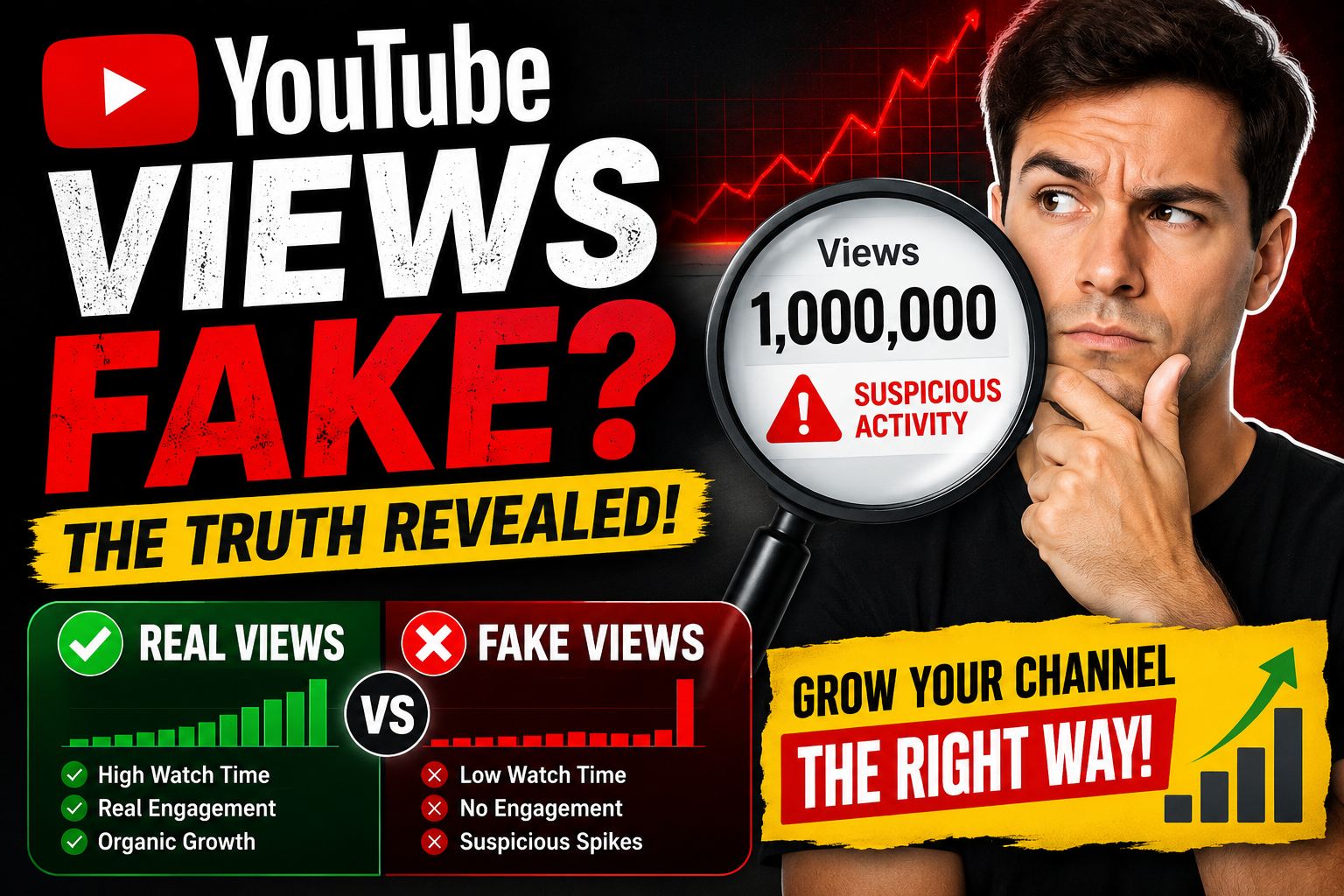
For example, if the video is about fake YouTube views, a thumbnail could use:
FAKE VIEWS?
with a YouTube-style analytics graphic and a visual contrast between real and artificial traffic.
The objective is not to trick people into clicking. It is to make the right people curious about a video that actually delivers what the thumbnail promises.
Use YouTube Shorts Strategically
Short-form content can introduce your channel to new viewers. But the same principle applies: the views need to come from genuine audience interest.
YouTube's monetization guidance specifically says artificial or fake Shorts views, including those generated by automated click or scroll bots, are ineligible for revenue-sharing calculations.
Use Shorts to demonstrate expertise, answer quick questions, highlight interesting moments, or introduce viewers to longer videos.
A Short does not have to become viral to be useful. It can simply attract the right viewer.
Promote Your Videos Legitimately
There are many legitimate ways to promote a YouTube video.
You can share it with your existing audience, embed it on your website, publish related social media content, collaborate with other creators, send it through an email newsletter, or use legitimate advertising.
The difference is that the audience is being given an opportunity to choose whether the content interests them.
YouTube's own policies do not prohibit creators from asking viewers to subscribe, like, share, or comment. What YouTube prohibits is artificial engagement and manipulative methods designed to inflate those metrics.
Why Watch Time and Audience Quality Matter
A view is only one piece of the picture.
Imagine two videos:
| Video | Views | Audience behavior |
|---|---|---|
| Video A | 50,000 | Very little meaningful engagement |
| Video B | 10,000 | Strong retention and repeat viewers |
The second video may be much more valuable to the creator even though its public view count is lower.
This is why creators should study their analytics instead of obsessing over the view counter.
Look for patterns in retention, traffic sources, returning viewers, engagement, and subscriber behavior. Then use those insights to improve your next videos.
Can Fake Views Help a Video Go Viral?
There is no safe strategy based on artificially inflating views to make a video viral.
YouTube explicitly prohibits artificial increases in views and other engagement metrics. It also says content and channels that violate the fake engagement policy can face removal or termination.
Even if artificial activity temporarily increases a number, it does not create the genuine audience signals that a successful channel needs.
A better approach is to create a strong initial package—topic + title + thumbnail + opening + valuable content—and then use legitimate promotion to put the video in front of relevant viewers.
Does Buying Views Guarantee More Subscribers?
No.
Views and subscribers are different outcomes. A viewer can watch a video without subscribing, while a loyal viewer may subscribe after watching several pieces of content.
If a service delivers artificial traffic, there is no reason to assume those viewers will become genuinely interested subscribers.
YouTube's policy also says subscribers identified as spam will not count toward the channel's total.
If your actual goal is channel growth, focus on attracting people who have a reason to watch your next video.
What Creators Should Do Instead of Buying Fake Views
A sustainable YouTube growth strategy can be built around five areas:
1. Topic selection: Find questions, problems, and subjects your target audience actually cares about.
2. Packaging: Create accurate, compelling titles and thumbnails.
3. Viewer retention: Make the video useful or entertaining from the beginning.
4. Distribution: Promote the content through legitimate channels where your audience already exists.
5. Analytics: Study what worked and use the information to create better videos.
This approach takes longer than purchasing an artificial number, but it builds something much more valuable: an audience.
YouTube Views Fake: The Bottom Line
The keyword “YouTube views fake” raises an important issue for creators, marketers, and viewers. Fake views are not simply low-quality views; artificial engagement is against YouTube's policies, and the platform says artificial traffic may be removed and can lead to enforcement action.
If you are evaluating a suspicious video, don't rely on one statistic. Look at the broader context and, when you have access to the channel's analytics, investigate traffic sources and audience behavior.
If you are a creator trying to increase views, the safest route is straightforward: make videos people genuinely want to watch, package them well, promote them legitimately, and use analytics to improve your next upload.
A smaller audience of real viewers is worth far more than a large number that exists only on a counter.
Frequently Asked Questions
What does “YouTube views fake” mean?
It generally refers to views that are artificially generated or manipulated rather than coming from people genuinely interested in watching a video. YouTube prohibits artificial increases in views and other engagement metrics.
Can YouTube remove fake views?
Yes. YouTube says traffic identified as artificial will not be counted and can lead to strikes or other enforcement action. Spam subscribers and other artificial activity may also be removed.
Can you tell if another YouTube channel has fake views?
Not reliably from the public view count alone. Unusual view-to-engagement ratios, traffic spikes, or unexpected audience patterns can be reasons to investigate, but none of these independently proves that a channel has fake views.
Are YouTube ads considered fake views?
No. Legitimate advertising is different from artificial engagement. The key distinction is whether views are generated through legitimate promotion and genuine viewer interaction rather than automated or deceptive traffic designed to manipulate metrics.
What is the safest way to increase YouTube views?
Create content around topics your audience genuinely wants, improve your titles and thumbnails, make strong videos, use Shorts strategically, collaborate with relevant creators, promote your content through legitimate channels, and study YouTube Analytics. Avoid services that promise artificial views or guaranteed engagement because YouTube's current policy prohibits artificial metric inflation.
