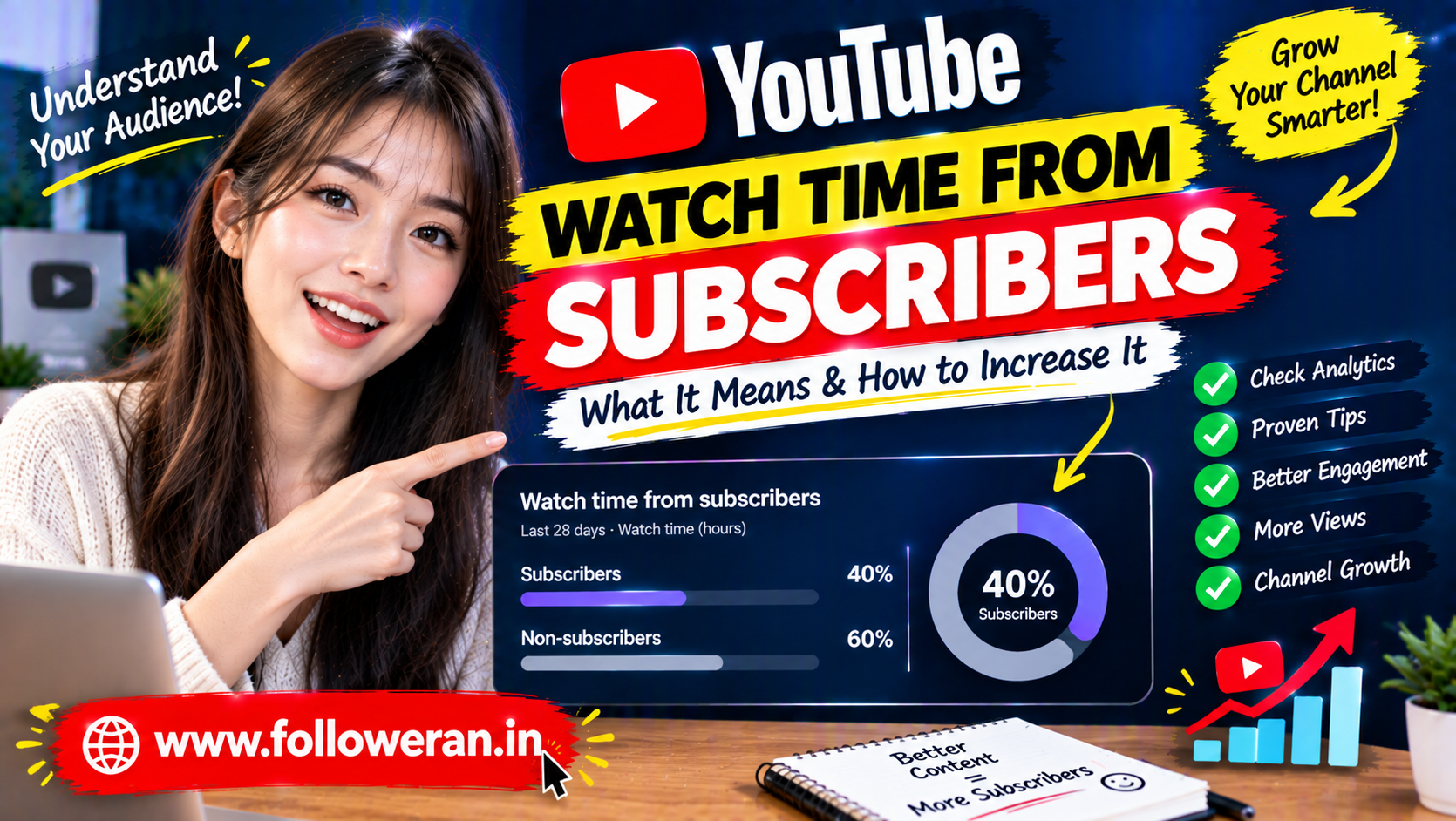
Watch Time From Subscribers YouTube: Meaning, Analytics & Growth Tips
If you have opened YouTube Studio Analytics and noticed the metric “watch time from subscribers,” you may wonder what it actually means and whether a high or low percentage is good.
The answer is simple:
Watch time from subscribers tells you what percentage of your channel's watch time came from viewers who were already subscribed to your channel, compared with viewers who were not subscribed.
This is useful because it helps you understand the relationship between your existing audience and your new or non-subscribed viewers.
For example, imagine your channel generated:
1,000 hours of total watch time
and:
400 hours came from subscribers
That means:
40% of watch time came from subscribers
and:
60% came from viewers who were not subscribed.
Neither number is automatically “good” or “bad.”
The important thing is understanding what the metric tells you about your channel.
What Is Watch Time From Subscribers on YouTube?
YouTube Analytics provides an audience report that divides watch time between:
Subscribers
and:
Viewers who are not subscribed
The metric is expressed as a percentage of your watch time.
For example:
| Audience | Watch Time |
|---|---|
| Subscribers | 35% |
| Non-subscribers | 65% |
This means non-subscribers generated most of the channel's watch time during the selected period.
It can be useful for understanding whether your channel is primarily being watched by:
Your existing community
or:
People discovering you for the first time.
Why Does Watch Time From Subscribers Matter?
The metric helps answer an important question:
Are my existing subscribers actually watching my content?
Subscriber count alone cannot answer that.
A channel may have:
50,000 subscribers
but only a small percentage of its watch time may come from those subscribers.
Another channel may have:
10,000 subscribers
with a highly active audience regularly watching new uploads.
This is why subscriber count should not be treated as a complete measure of audience health.
Watch Time From Subscribers vs Total Watch Time
These metrics are related but different.
Total Watch Time
The amount of time viewers watched your content during the selected period.
Watch Time From Subscribers
The percentage of that watch time generated by subscribed viewers.
For example:
Total watch time = 1,000 hours
Subscriber watch time = 300 hours
Therefore:
Subscriber watch-time share = 30%
This helps you understand who is contributing to the total.
How to Check Watch Time From Subscribers
You can generally find the report inside YouTube Studio Analytics under the audience-related reports.
A typical route is:
YouTube Studio
↓
Analytics
↓
Audience
↓
Watch time from subscribers
The exact layout can vary because YouTube regularly updates Studio's interface.
You may see the data divided into:
Subscribed
and:
Not subscribed
Review the selected date range before making comparisons.
Why the Date Range Matters
Suppose you compare:
Last 28 days
with:
Last 365 days
The subscriber watch-time percentages may be very different.
A channel that recently published several subscriber-focused videos could have:
Higher subscriber watch time in the last 28 days
but:
Lower subscriber watch time over the past year.
Always compare similar time periods when measuring trends.
Is a High Subscriber Watch-Time Percentage Good?
Not necessarily.
A high percentage can mean:
Your existing audience is highly engaged
which can be positive.
But it can also mean:
You are not reaching enough new viewers.
For example:
Subscriber watch time = 80%
could indicate a loyal community.
But if your objective is aggressive channel discovery, you may also want more non-subscribers discovering your content.
Is a Low Subscriber Watch-Time Percentage Bad?
Again, not automatically.
Suppose:
Subscriber watch time = 20%
and:
Non-subscriber watch time = 80%
That could mean your videos are reaching many new viewers.
For a channel focused on discovery, that may be a positive sign.
The next opportunity is converting some of those new viewers into regular viewers and subscribers.
The Best Balance Depends on Your Goal
Different channels have different objectives.
New channel
A high share of non-subscriber watch time can be useful because the channel needs discovery.
Established community
A stronger subscriber watch-time share can indicate an active existing audience.
Business channel
Both audiences matter because new viewers can become customers while subscribers can become repeat viewers.
Educational channel
A healthy mix can bring in new learners while retaining existing students.
There is no universal ideal percentage.
Watch Time From Subscribers and Audience Loyalty
One reason this metric matters is that subscribers have already taken an action:
They chose to follow your channel.
If those subscribers continue watching new videos, it suggests that your content is meeting an ongoing audience expectation.
However, subscribing does not guarantee future viewing.
Subscribers can:
Lose interest
Stop using YouTube
Become inactive
Change interests
Watch only selected uploads
YouTube also provides separate audience categories such as new, casual and regular viewers, which can give additional context.
Subscribers Do Not Always Watch
This is one of the biggest misconceptions about YouTube.
Having:
10,000 subscribers
does not mean every video will receive:
10,000 views.
A subscriber may have subscribed months or years ago and may no longer actively watch the channel.
That's why audience activity is more informative than subscriber count alone.
Watch Time From Subscribers vs Returning Viewers
These are related concepts but not identical.
Subscriber
A viewer who is subscribed to the channel.
Returning Viewer
A viewer who has watched your channel previously and comes back during the selected period.
A returning viewer may or may not be subscribed.
This means you can have:
Returning non-subscribers
and:
Inactive subscribers.
Looking at both metrics provides a better understanding of audience loyalty.
Watch Time From Subscribers and Monthly Audience
YouTube also provides a monthly audience measure based on unique viewers over a recent period.
This helps estimate your active audience size.
For example:
Subscribers = 100,000
but:
Monthly audience = 30,000
That tells you that your active audience is much smaller than your total subscriber base during that period.
This is not necessarily a problem.
It's a reminder that subscriber count and active viewership are different measurements.
How to Increase Watch Time From Subscribers
If you want more of your subscribers to watch your content, focus on giving them a strong reason to return.
The process is:
Understand subscribers → Publish relevant content → Notify and attract them → Keep them watching → Build repeat habits
1. Create Content Subscribers Actually Want
Your subscribers subscribed for a reason.
Ask:
What did they originally subscribe for?
If they subscribed for:
YouTube tutorials
but you suddenly publish:
Random travel videos
they may stop watching.
Keep your main content promise consistent.
2. Understand Why People Subscribed
Look at your best-performing subscriber-generating videos.
For example:
Video A: YouTube SEO
Video B: Thumbnail design
Video C: YouTube monetisation
If these topics consistently generate subscribers, your audience may be particularly interested in educational YouTube content.
Create more around those themes.
3. Create Follow-Up Videos
If one video performs well, make related videos.
For example:
How to Create a YouTube Thumbnail
followed by:
5 YouTube Thumbnail Mistakes
then:
How to Improve YouTube CTR
This gives subscribers a reason to return.
4. Build Content Series
Series are excellent for recurring viewing.
For example:
Part 1: Channel Setup
Part 2: Keyword Research
Part 3: Thumbnail Design
Part 4: Video SEO
Part 5: Subscriber Growth
A subscriber who watches Part 1 has a natural reason to watch Part 2.
5. Use Consistent Publishing
Consistency helps create audience expectations.
For example:
New tutorial every Monday
or:
Two new videos every week
The exact schedule matters less than choosing a schedule you can maintain.
6. Improve Your Titles
Subscribers still need a reason to click.
Instead of:
“New Video #15”
use:
“5 YouTube SEO Mistakes Killing Your Views”
A clear benefit is easier to understand.
7. Improve Your Thumbnails
Your subscribers may see dozens of videos in their feed.
A strong thumbnail should communicate:
Topic
Benefit
Curiosity
in a fraction of a second.
Keep the design simple and readable.
8. Start Videos Quickly
If the first minute contains a long introduction, viewers may leave.
Instead:
Introduce the problem
↓
Explain the value
↓
Start solving it
For example:
“In this video, I'll show you five changes that can increase subscriber retention. Let's start with the first one.”
9. Give Subscribers a Reason to Continue Watching
Use:
Related videos
Playlists
End screens
Cards where appropriate
A strong viewing journey can become:
Video A
↓
Video B
↓
Video C
This can increase session depth and total watch time.
10. Use End Screens Strategically
The next video should be highly relevant.
If someone watches:
YouTube SEO Tutorial
don't recommend:
Unrelated Vlog
Instead suggest:
YouTube Keyword Research Guide
Relevance improves the chance that subscribers continue watching.
11. Create Playlists
Playlists can make it easier for subscribers to consume multiple related videos.
For example:
YouTube Growth Course
Channel Setup
Content Research
Titles
Thumbnails
SEO
Analytics
Subscriber Growth
This creates a structured viewing path.
12. Use Community Posts
Community content can keep your audience engaged between uploads.
You can post:
Polls
Questions
Video previews
Announcements
Behind-the-scenes updates
Topic requests
This can remind existing viewers that your channel is active.
13. Use YouTube Live
Live streams can strengthen relationships with subscribers.
Possible formats include:
Q&A
Tutorials
Interviews
Workshops
Reviews
Community discussions
Live viewers may also become more engaged returning viewers.
14. Ask Subscribers What They Want
You can simply ask:
“What should I cover next?”
Offer several choices.
For example:
A. YouTube SEO
B. Thumbnail design
C. Shorts
D. Monetisation
The results can guide your content calendar.
15. Use Comments as Research
Your comment section can reveal what subscribers want.
Look for:
Repeated questions
Topic requests
Problems
Suggestions
Turn those comments into follow-up videos.
16. Respond to Subscriber Comments
When subscribers see that the creator responds, the community can feel more active.
You don't need to answer every comment manually, but useful questions deserve attention.
17. Make Subscriber-Exclusive Content
Depending on your channel and available features, consider offering:
Bonus videos
Members-only material
Live sessions
Extended tutorials
Behind-the-scenes content
Give your most loyal audience a reason to remain engaged.
18. Use a Clear Content Promise
Subscribers should know what is coming next.
For example:
“Every week: practical digital-marketing tutorials.”
This builds an expectation around your channel.
19. Keep Your Niche Consistent
Audience expectations matter.
If someone subscribes because they want:
Fitness videos
and suddenly your channel becomes:
Gaming tutorials
your subscriber watch time may decline.
Consistency doesn't mean repetition.
It means staying within a recognizable content area.
20. Build Trust With Subscribers
Trust grows when you consistently:
Deliver what you promise
Provide useful information
Avoid misleading titles
Respond to feedback
Maintain quality
A subscriber who trusts your content is more likely to return.
21. Measure Watch Time by Content Type
Different formats can attract different audiences.
For example:
| Content Type | Subscriber Watch Time |
|---|---|
| Long-form videos | 40% |
| Shorts | 15% |
| Live streams | 65% |
This could suggest that your subscribers are especially engaged with long-form content and livestreams.
Use your own data to determine which formats deserve more attention.
22. Compare New vs Returning Audiences
A video can be successful for two different reasons.
New-audience success
Many non-subscribers discover it.
Subscriber success
Existing subscribers watch heavily.
Ideally, your content strategy can do both over time.
23. Create Discovery Content
Discovery content is designed to attract new viewers.
Examples:
How-to tutorials
Search-focused videos
Trending topics
Beginner guides
These can increase non-subscriber watch time and expose your channel to new audiences.
24. Create Loyalty Content
Loyalty content is designed for existing viewers.
Examples:
Advanced tutorials
Series
Community updates
Live Q&A
Deep-dive videos
These can strengthen subscriber watch time.
A balanced channel needs both.
25. Create Bridge Content
Bridge content connects new viewers and subscribers.
For example:
Beginner guide
↓
Advanced tutorial
↓
Complete series
A new viewer enters through the beginner video.
They subscribe.
Then they watch the advanced content.
This creates a natural audience journey.
26. Improve Viewer Retention
If subscribers click but stop watching quickly, review your audience-retention data.
Look for:
Large early drop-offs
Slow sections
Unnecessary repetition
Weak transitions
Long introductions
Fix one issue at a time and compare future videos.
27. Use Better Storytelling
Even educational videos benefit from structure.
A simple framework is:
Problem
↓
Why it matters
↓
Solution
↓
Example
↓
Result
A structured video can be easier to follow.
28. Add Examples
Examples make abstract ideas more useful.
Instead of saying:
“Improve your thumbnail.”
show:
Before thumbnail
→
After thumbnail
→
Why the second version communicates better
This can help viewers understand the lesson.
29. Keep Videos Focused
Long does not automatically mean better.
A 10-minute video with:
10 useful minutes
may outperform a 20-minute video padded with repetition.
Make the video as long as necessary to solve the problem.
30. Use Analytics to Find Subscriber-Focused Topics
Create a spreadsheet containing:
Video
Views
Watch time
Subscribers gained
Subscriber watch-time share
Topic
Patterns may emerge.
For example:
SEO videos → high subscriber retention
News videos → high non-subscriber reach
That tells you how different content types serve different audiences.
31. How to Interpret Subscriber Watch Time
Imagine your report shows:
Subscribers = 60%
Non-subscribers = 40%
This may indicate a strong existing community.
Now imagine:
Subscribers = 20%
Non-subscribers = 80%
This may indicate strong discovery.
Neither number should be judged without context.
32. What if Subscriber Watch Time Is Too Low?
Start by checking:
Are subscribers interested in my recent topics?
Did I change my niche?
Are titles and thumbnails appealing?
Are subscribers receiving notifications?
Are new videos relevant to existing viewers?
Are my videos retaining viewers?
Low subscriber watch time often requires a content and audience review rather than a single technical fix.
33. What if Subscriber Watch Time Is Very High?
High subscriber watch time can be positive.
But ask:
Are new viewers discovering the channel?
If almost all watch time comes from subscribers, you may have a strong community but limited new-audience reach.
Add discovery-oriented videos where appropriate.
34. Don't Chase a Specific Percentage
Avoid setting a goal such as:
“I need 70% subscriber watch time.”
There is no universal ideal percentage.
A better approach is:
Improve the quality and activity of your audience over time.
Track trends rather than one number.
35. Watch Time From Subscribers and YouTube Monetisation
Subscriber watch time is useful for audience analysis, but it should not be confused with YouTube's monetisation eligibility calculations.
YouTube uses specific eligibility measures and distinguishes between different types of watch hours and views.
Therefore:
Subscriber watch-time percentage ≠ monetisation progress
Use the appropriate monetisation-related metrics separately.
36. Does Watching Your Own Videos Increase Subscriber Watch Time?
The purpose of Analytics is to measure genuine audience activity.
Do not try to manipulate watch time through repeated self-watching or artificial viewing.
Artificial traffic can make analytics less reliable and may create platform-policy concerns.
Focus on genuine viewers.
37. Do Purchased Subscribers Increase Watch Time?
Not necessarily.
A purchased or artificially generated subscriber may never watch your future videos.
You could end up with:
More subscribers
but:
Little additional watch time
This is why audience quality matters more than simply increasing the subscriber counter.
38. Do Free Subscriber Services Improve Watch Time?
Again, not necessarily.
A free subscriber service may increase the displayed subscriber number, but unless those people are genuinely interested in your content, they may not become regular viewers.
A better strategy is to build:
Relevant viewers
who naturally become:
Subscribers
and then:
Returning viewers
39. Why Relevant Subscribers Matter
Suppose a channel publishes:
Digital-marketing tutorials
It is better to attract:
5,000 people interested in marketing
than:
20,000 random accounts
The smaller audience may produce more:
Watch time
Comments
Shares
Leads
Customers
40. Use Traffic Sources to Understand Subscriber Watch Time
Different traffic sources can attract different audience types.
Examples include:
YouTube Search
Suggested videos
Browse features
External websites
Social media
Compare which sources produce viewers who actually return and watch more content.
41. Create Videos for Search and Existing Subscribers
Search videos can attract:
New viewers
while follow-up videos can serve:
Existing subscribers
For example:
Search video:
“How to create a YouTube thumbnail”
then:
Subscriber-focused video:
“10 advanced thumbnail mistakes to avoid”
The first introduces new viewers.
The second gives existing viewers another reason to return.
42. Create a Content Funnel
A simple YouTube audience funnel can be:
New Viewer
↓
Useful Video
↓
Channel Visit
↓
Subscribe
↓
Next Video
↓
Returning Viewer
↓
Loyal Subscriber
Watch time from subscribers becomes more valuable as people move further down this funnel.
43. Use Related Video Linking
When one video naturally connects to another, guide the viewer.
For example:
YouTube SEO basics
→
Keyword research
→
Title optimisation
→
Thumbnail optimisation
→
Analytics
This makes the content library work together.
44. Improve Your Channel Homepage
Your homepage should make it easy for subscribers and new visitors to discover relevant videos.
Organise:
Featured video
Popular uploads
Playlists
Recent content
Topic-based sections
45. Keep Older Subscribers Interested
Some subscribers may have joined because of an older topic.
Refresh relevant subjects.
For example:
Old video:
YouTube SEO Guide
New video:
YouTube SEO Guide Updated for 2026
This can reconnect with existing subscribers while attracting new search traffic.
46. Update Successful Topics
A topic that performed well in the past may deserve another version.
Look at:
Top views
Top subscriber gains
Top watch time
Strongest retention
Then decide whether there is a reason to revisit the topic.
47. Use Audience Feedback
Ask subscribers:
What is missing from my channel?
You might discover:
More tutorials
Shorter videos
More case studies
More live sessions
Your audience can directly tell you how to improve.
48. Segment Your Audience Mentally
Even without complicated systems, think in groups:
New viewers
Need a clear introduction.
Casual viewers
Need a reason to return.
Subscribers
Need consistent value.
Regular viewers
Need deeper community connection.
This helps you create content for different stages of the audience journey.
49. A Simple Subscriber Watch-Time Improvement Plan
Week 1
Review your highest-subscriber-watch-time videos.
Week 2
Create two follow-up videos around those topics.
Week 3
Build or improve playlists connecting related content.
Week 4
Review retention and subscriber watch-time trends again.
Repeat the process.
50. Metrics to Review Alongside Subscriber Watch Time
Don't analyse this metric alone.
Also review:
Watch time
Average view duration
Audience retention
Subscribers gained
Returning viewers
New viewers
Monthly audience
Traffic sources
Together, these metrics provide much more context.
Example YouTube Audience Analysis
Imagine your channel reports:
| Metric | Result |
|---|---|
| Total watch time | 1,000 hours |
| Subscriber share | 35% |
| Non-subscriber share | 65% |
| New viewers | 18,000 |
| Returning viewers | 6,000 |
| Subscribers gained | 750 |
What does this suggest?
Your channel is reaching many new people.
At the same time, a meaningful portion of watch time comes from subscribers.
The next opportunity may be converting more new viewers into regular viewers and subscribers.
Another Example
Suppose a channel reports:
| Metric | Result |
|---|---|
| Total watch time | 800 hours |
| Subscriber share | 75% |
| Non-subscriber share | 25% |
| New viewers | 4,000 |
| Returning viewers | 9,000 |
| Subscribers gained | 120 |
This may suggest strong loyalty among the existing audience but relatively limited discovery.
The channel could experiment with:
Search-focused videos
Collaborations
Shorts
Broader entry-level topics
to attract new viewers.
Watch Time From Subscribers for Businesses
Businesses should consider subscriber watch time as part of audience quality.
For example, a business YouTube channel might publish:
Product tutorials
FAQs
Customer case studies
How-to videos
Subscribers who repeatedly watch these videos may be more likely to understand the brand.
But businesses should also track:
Website clicks
Leads
Enquiries
Sales
Watch Time From Subscribers for Educators
Educational channels can use subscriber watch time to identify:
Topics students return to
Lessons worth expanding
Subjects that need follow-ups
For example:
Excel formulas
may generate strong subscriber watch time.
That could justify creating:
Advanced Excel
Excel shortcuts
Excel dashboards
and related lessons.
Watch Time From Subscribers for Influencers
Influencers can study which content keeps existing followers watching.
For example:
Behind-the-scenes content
may generate more subscriber watch time than:
General trend videos
That information can shape future uploads.
Watch Time From Subscribers for Gaming Channels
Gaming channels can compare:
Gameplay
Walkthroughs
Reviews
Tips
Live streams
Some formats may generate more watch time from existing subscribers while others reach new viewers.
Use the data to balance both goals.
Watch Time From Subscribers for Faceless Channels
Faceless channels can use the same strategy.
Whether you create:
Tutorials
Explainers
Screen recordings
Animations
the key question is still:
Are existing viewers coming back to watch?
Common Mistakes When Analysing Watch Time From Subscribers
Treating high as always good
High can mean loyalty, but it can also mean limited discovery.
Treating low as always bad
Low can mean your channel is attracting many new viewers.
Looking only at subscriber count
Subscribers are not the same as active viewers.
Ignoring returning viewers
Returning viewers provide valuable context.
Ignoring retention
Watch time without retention analysis leaves out important information.
Comparing unrelated time periods
Use consistent date ranges.
Chasing artificial watch time
Focus on genuine viewers.
Frequently Asked Questions
What does watch time from subscribers mean on YouTube?
It shows what percentage of your channel's watch time came from viewers who are subscribed compared with viewers who are not subscribed.
Where can I find watch time from subscribers?
You can generally find it in YouTube Studio → Analytics → Audience, although the exact interface may change as YouTube updates Studio.
Is high watch time from subscribers good?
It can indicate a strong, engaged existing audience, but there is no universal ideal percentage. You should also consider new viewers and overall channel discovery.
Is low watch time from subscribers bad?
Not necessarily. A low subscriber share may mean that many non-subscribers are discovering your content.
What is a good watch time from subscribers percentage?
There is no single percentage that is ideal for every channel. Your niche, channel size, traffic sources and growth goals all matter.
Does subscriber watch time help grow a YouTube channel?
It can indicate that your existing audience is actively watching, which is useful for understanding loyalty and content relevance.
Does subscriber watch time count toward YouTube watch hours?
Watch time is measured in YouTube Analytics, but specific YouTube Partner Program eligibility calculations use their own definitions and qualifying metrics. Do not treat the subscriber-share percentage as a monetisation counter.
How can I increase watch time from subscribers?
Create content relevant to your subscribers, produce follow-up videos, build series and playlists, improve titles and thumbnails, strengthen audience retention and give viewers good reasons to return.
Why is my subscriber watch time low?
Possible reasons include strong new-viewer discovery, inactive subscribers, a change in niche, topics that don't match subscriber interests or weak returning-viewer behaviour.
Why is my subscriber watch time high?
It can indicate an active existing audience. However, check whether your channel is also attracting enough new viewers.
Does subscriber count equal active viewers?
No. Subscribers can become inactive, watch only occasionally or stop returning to a channel.
What is the difference between subscriber watch time and returning viewers?
Subscriber watch time measures how much watch time comes from subscribers. Returning viewers measures viewers who have previously watched your channel and come back during the selected period.
Can a non-subscriber be a returning viewer?
Yes. A viewer can return to your channel without subscribing.
Can purchased subscribers increase watch time?
There is no guarantee. Subscribers who are not genuinely interested in your content may not watch future videos.
Should I buy subscribers to increase watch time?
Buying subscribers does not guarantee additional watch time and can create low-quality audience data. Genuine content-driven growth is a better approach.
Do Shorts contribute to subscriber watch time?
Analytics can be filtered by different content types, including Shorts, but metrics and eligibility calculations can differ by format. Review the specific YouTube Studio report for the content type you're analysing.
Can livestreams increase subscriber watch time?
Yes, livestreams can generate significant watch time from existing viewers when the topic is relevant and the audience actively participates.
How can I get subscribers to watch every video?
No channel can make every subscriber watch every upload. Focus on relevant topics, consistent quality, strong titles and thumbnails, audience expectations and repeatable content formats.
Should I focus on subscribers or watch time?
Both matter for different reasons. Subscribers show how many people chose to follow your channel, while watch time shows actual viewing activity.
What other metrics should I check?
Review watch time, average view duration, audience retention, new viewers, returning viewers, monthly audience, subscribers gained and traffic sources.
Final Thoughts
The YouTube metric “watch time from subscribers” is valuable because it tells you who is actually contributing to your watch time.
It helps answer questions such as:
Are my subscribers still watching?
Are new viewers discovering my channel?
Which content keeps my existing audience interested?
Is my subscriber base active?
Remember that there is no perfect percentage.
A high subscriber share may indicate strong audience loyalty.
A lower subscriber share may indicate strong discovery by new viewers.
The best channel usually needs both:
New viewers → Discovery
and:
Subscribers → Loyalty
Use YouTube Analytics to study the relationship between:
Watch time
Subscribers
New viewers
Returning viewers
Audience retention
Traffic sources
Then build content that serves both sides of your audience.
The strongest strategy is:
Attract new viewers → Give them a reason to subscribe → Deliver consistent value → Encourage repeat viewing → Build an active subscriber community.
That is how watch time from subscribers on YouTube becomes more than an Analytics metric—it becomes a useful indicator of whether your channel is building a real, returning audience.
