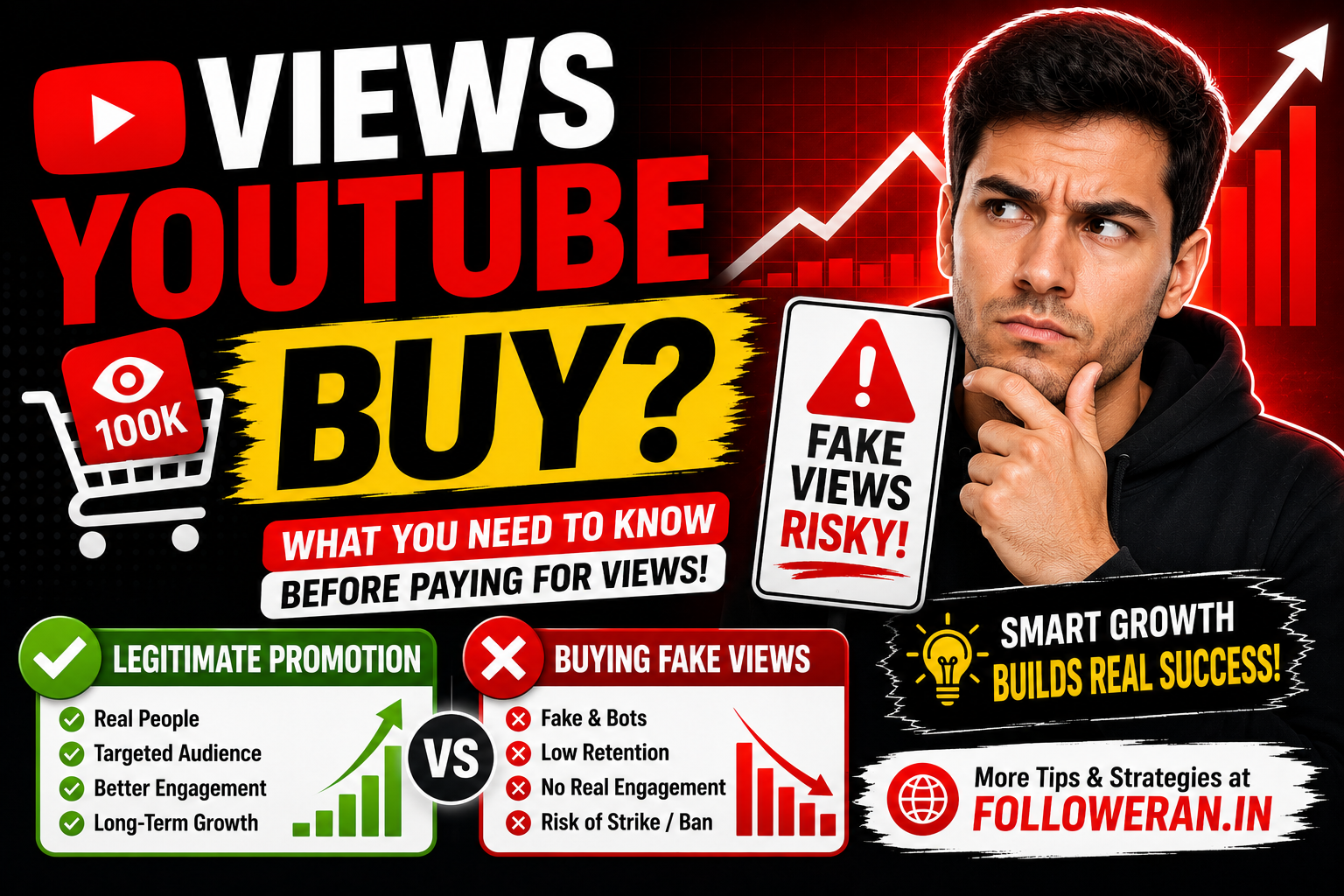
Views YouTube Buy: What You Need to Know Before Paying for Views
If you are searching for “views YouTube buy”, you are probably looking for a quick way to increase the number displayed on your YouTube videos. Buying views can sound attractive, especially when a new channel has good content but very few people are discovering it. However, there is an important difference between legitimate paid promotion and services that artificially inflate a video's view count.
YouTube's current Fake Engagement Policy does not allow methods that artificially increase views, likes, comments, subscribers, or other metrics through automatic systems or by serving videos to unsuspecting viewers. YouTube also states that artificial traffic may not be counted and can result in strikes or other enforcement action.
That doesn't mean you cannot spend money to promote a YouTube video. The important question is what you are actually paying for. Legitimate advertising puts your content in front of potential viewers through an advertising system, while artificial view services may attempt to manufacture the metric itself.
If your goal is long-term channel growth, understanding this difference can save you money, protect your channel, and help you build an audience that actually watches your content.
What Does “Views YouTube Buy” Mean?
The phrase “views YouTube buy” is commonly used by people searching for ways to purchase YouTube views. Searchers may have different intentions: some want to understand whether buying views works, some want to compare paid promotion options, and others simply want to make a new video look more popular.
The important distinction is between paid discovery and artificial engagement.
Paid discovery means you spend money to introduce your video to an audience through legitimate advertising or promotion. Those viewers can decide whether they want to watch your content.
Artificial engagement is different. YouTube specifically prohibits systems or services designed to artificially increase views and other engagement metrics.
So, before spending money, don't simply ask:
“How many views will I get?”
Ask:
“Where will these viewers come from, and are they genuinely interested in my content?”
That question can completely change the quality of your promotion strategy.
Is It Safe to Buy YouTube Views?
If by “buy views” you mean purchasing artificial views from a third-party service, it is not a safe strategy for a YouTube channel.
YouTube's current policy explicitly prohibits artificial increases in views and other metrics. It also warns creators that hiring another person or company does not necessarily protect them from consequences. If the promotion method violates YouTube's policies, the creator's channel can be affected even when someone else performed the activity.
YouTube says artificial traffic may be removed from its metrics and can lead to strikes. In serious or repeated cases, content or channels may be removed.
This creates an important risk/reward problem.
You might spend money to increase a visible number temporarily, only to have some or all of that traffic removed later. Worse, the activity could create policy problems for the channel.
For a business channel or monetized creator account, that risk can be much more expensive than the original purchase.
What Is the Difference Between Paid Promotion and Fake Views?
The difference comes down to how the viewer arrives and why they watch.
Imagine you create a video about photography.
With legitimate promotion, your video could be shown to people who have demonstrated an interest in photography. They see the promotion, decide whether the video looks useful, and choose to watch.
With artificial traffic, the service's primary objective may simply be generating a predetermined number of views.
The first approach is audience acquisition.
The second is metric manipulation.
YouTube defines legitimate engagement around authentic human interaction, while it considers engagement illegitimate when it results from deception, coercion, or activity whose primary purpose is financial gain rather than genuine interaction.
That's why the source and intent behind the traffic matter much more than the number advertised by a service.
Can YouTube Remove Purchased Views?
Yes.
YouTube says traffic identified as artificial will not be counted. It also explains that additional verification and spam reviews can cause displayed metrics to differ from Analytics figures.
This means a service claiming to deliver a specific number of views cannot guarantee that those views will remain part of your legitimate YouTube metrics.
YouTube also says that terminated accounts and subscribers identified as spam do not count toward subscriber totals or views.
So if you see a sudden increase followed by a decrease, it doesn't necessarily mean YouTube is randomly removing legitimate viewers. Some traffic may have been identified as artificial or invalid.
Why Artificial Views Usually Don't Build a Real Audience
Imagine that you buy 50,000 views for a video.
The number looks impressive.
But what happens next?
Do those people watch your other videos? Do they subscribe because they genuinely like your content? Do they return next week? Do they share the video with friends? Do they become customers if you run a business?
If the answer is no, the 50,000 views haven't solved the real growth problem.
A successful YouTube channel needs an audience that has a reason to come back.
That's why audience quality matters more than raw view count.
A smaller video with 5,000 highly interested viewers can create more long-term value than a video with 100,000 low-quality or artificial views.
Can Buying Views Help a Video Go Viral?
There is no reliable shortcut where purchasing artificial views causes YouTube to recommend a video widely.
YouTube's systems evaluate content and viewer behavior in context. Its Analytics tools let creators examine impressions, click-through rate, views, watch time, average view duration, and audience retention.
Artificially increasing one metric doesn't automatically create genuine audience demand.
Think of a video as a restaurant.
You can put a huge number on the sign saying “100,000 customers served.” But if people walk into the restaurant, take one bite, and leave, the number doesn't solve the underlying problem.
A better restaurant gets people to:
enter → enjoy the food → stay → return → recommend it
YouTube growth works in a similar way.
What YouTube Analytics Can Tell You
If your goal is to increase views, YouTube Analytics is more valuable than a purchased view package because it tells you what is actually happening with your content.
YouTube's current Analytics system provides information about impressions, click-through rate, views, unique viewers, watch time, average view duration, and audience retention. It also shows how viewers found your content through sources such as YouTube Search, browse features, Suggested Videos, Shorts Feed, and external sources.
That information gives you a practical way to diagnose problems.
| What you see | What you should investigate |
|---|---|
| Low impressions | Topic demand, competition, audience fit |
| Many impressions but few clicks | Title and thumbnail |
| Good clicks but poor retention | Introduction and content quality |
| Good retention but limited reach | Topic, audience, competition |
| Strong views but few subscribers | Audience fit and channel positioning |
| Strong video performance | Create related content |
This is much more useful than simply asking how many views you can purchase.
Improve Your YouTube Thumbnail
One of the first places to look when a video gets impressions but few views is the thumbnail and title.
YouTube describes impressions as the number of times thumbnails are shown to viewers, while click-through rate measures how often viewers watch after seeing the thumbnail.
That means your thumbnail is part of the viewer's decision-making process.
A strong thumbnail should communicate the video's subject immediately.
For example, instead of a cluttered thumbnail containing:
HOW TO GET MORE YOUTUBE VIEWS IN 2026 BEST STRATEGIES FOR NEW CHANNELS
you could use something much simpler:
MORE VIEWS?
with a clear visual representing YouTube analytics.
The title can provide the additional context.
Your thumbnail and title should work together rather than compete with each other.
Write Better YouTube Titles
A good title gives the viewer a clear reason to click.
If your video teaches creators how to grow their channels, compare:
“YouTube Growth Tips”
with:
“How to Increase YouTube Views Without Buying Fake Traffic”
The second title is more specific.
It identifies a problem and provides a potential solution.
But don't promise something your video doesn't actually deliver. YouTube's spam policy prohibits misleading behavior intended to manipulate engagement or mislead viewers.
The strongest titles create curiosity while remaining accurate.
Improve the First 30 Seconds
A viewer who clicks your video has already given you an opportunity.
Now you need to earn the next few seconds.
Don't spend the opening of the video with a long introduction about your channel.
Instead, establish the value immediately.
For example:
“If you're thinking about buying YouTube views, there are two very different types of paid promotion you need to understand before spending money.”
That opening immediately connects with the viewer's reason for clicking.
Then deliver useful information.
The goal isn't to trick somebody into staying. It's to make them glad they clicked.
Use YouTube Search to Attract Relevant Viewers
If your video answers a specific question, YouTube Search can be an important discovery source.
A video targeting the topic “how to increase YouTube views” could focus on questions such as:
- How to get more views on YouTube
- Why my YouTube videos aren't getting views
- How to improve YouTube CTR
- How to increase YouTube watch time
- How to get YouTube views organically
The key is to create a genuinely useful answer rather than stuffing keywords into your title and description.
YouTube Analytics can show how viewers found your videos, including YouTube Search and other discovery surfaces.
Use that information to understand which subjects are attracting your audience.
Use Legitimate Promotion to Increase YouTube Views
If you have a marketing budget, you don't necessarily need to avoid paid promotion.
Instead, spend the money on legitimate audience acquisition.
You can promote your content through appropriate advertising channels, collaborate with creators whose audiences overlap with yours, sponsor relevant content, promote your videos on your website, or use other legitimate marketing methods.
The goal is to put your video in front of people who might genuinely care about it.
This creates a much healthier process:
Promotion → relevant viewer → genuine click → watch → engagement → potential subscriber
That's very different from:
Payment → artificial traffic → inflated counter
One builds an audience.
The other attempts to build a number.
Why Watch Time Matters
Views tell you that someone watched, but watch time provides additional context about how much viewing occurred.
YouTube Analytics includes watch time and average view duration among its key video metrics.
Suppose two videos each receive 10,000 views.
Video A has viewers who leave almost immediately.
Video B has viewers who watch a significant portion of the content.
The two videos may have identical view counts, but the audience behavior is very different.
This is why increasing the quality of the viewing experience is so important.
Don't just ask:
“How do I get more people to click?”
Ask:
“How do I give people a reason to keep watching?”
Create Videos Around One Clear Problem
One of the simplest ways to improve YouTube performance is to make each video about a clear subject.
For example:
Bad concept:
Everything You Need to Know About YouTube
That's too broad.
Better concept:
Why Your YouTube Videos Get Impressions but No Views
Now the viewer knows exactly what problem you're addressing.
A focused topic also makes it easier to create the title, thumbnail, introduction, and structure.
The clearer the promise, the easier it becomes to deliver a satisfying video.
Create Related Videos
Don't think about each video as an isolated piece of content.
Build content clusters.
For example:
YouTube Growth Cluster
Video 1: How to Increase YouTube Views
Video 2: How to Improve YouTube CTR
Video 3: How to Get More YouTube Subscribers
Video 4: How to Improve YouTube Watch Time
Video 5: How to Create Better YouTube Thumbnails
Video 6: Why YouTube Videos Stop Getting Views
A viewer interested in one topic is more likely to be interested in the others.
This gives your channel a clear purpose.
Don't Buy Views Just to Impress Other People
This is an underrated point.
Some creators become focused on the public number because they worry about how their channel looks.
They see a competitor with 100,000 views and think:
“My video only has 800. Nobody will take me seriously.”
But numbers without audience quality don't create a successful business.
If you're building a personal brand, business, educational channel, or entertainment brand, the real asset is attention from the right people.
One genuine viewer who becomes a customer can be worth more than thousands of meaningless views.
Focus on the people you actually want to reach.
What If Someone Else Sends Fake Traffic to Your Video?
You may sometimes notice unexpected traffic that you didn't intentionally purchase or generate.
YouTube says its systems analyze traffic to determine whether it is valid or invalid, regardless of where or how the traffic originated.
If you're concerned about unusual activity, review your YouTube Analytics and traffic sources rather than immediately purchasing more traffic.
YouTube also advises creators to carefully vet promotion partners because third-party services claiming to help build channels may potentially drive invalid traffic without the creator fully understanding how the traffic is generated.
Keep records of legitimate advertising and promotional campaigns so you can understand where your traffic originated.
What Happens If YouTube Detects Artificial Traffic?
The consequences depend on the circumstances and severity.
YouTube says artificial traffic may not be counted and can lead to strikes. Content or channels that violate the Fake Engagement Policy may be removed, and repeated or severe violations can result in channel termination.
For creators participating in the YouTube Partner Program, artificial engagement can also create monetization risks. YouTube's monetization policies state that creators should not artificially inflate engagement such as views, subscribers, likes, watch time, or ad impressions.
That makes artificial views particularly unattractive for channels that are trying to build a long-term business.
How to Increase YouTube Views Without Buying Fake Views
If you want more views, use this practical framework:
1. Find a topic people care about
Choose subjects that solve problems or provide entertainment for your target audience.
2. Improve the title
Make the promise specific and accurate.
3. Design a clear thumbnail
Make the subject understandable in a fraction of a second.
4. Strengthen your opening
Give viewers a reason to continue immediately.
5. Improve retention
Remove unnecessary sections and keep delivering value.
6. Study Analytics
Use impressions, CTR, views, watch time, and retention to understand what is working.
7. Create follow-up videos
When a topic works, explore closely related subjects.
8. Promote legitimately
Use advertising, social media, websites, collaborations, and other legitimate channels.
9. Build a recognizable niche
Make it obvious why someone should subscribe to your channel.
10. Repeat what works
YouTube growth is usually a process of testing, learning, and improving.
Is Buying YouTube Views Ever Worth It?
If the phrase “buy YouTube views” means paying for legitimate advertising or audience promotion, paid distribution can be a reasonable part of a marketing strategy.
If it means purchasing artificial views from a service that promises to inflate the counter, the risks are much greater.
The distinction is critical.
You are not really buying views.
You are choosing between buying exposure to potential viewers and buying an artificial metric.
Exposure can lead to real audience growth.
An artificial metric may disappear when YouTube detects invalid activity.
YouTube explicitly says artificial traffic will not be counted and that creators can face enforcement action for artificial engagement.
Final Thoughts
The search term “views YouTube buy” reflects a common problem for creators: getting a new video noticed is difficult, and the temptation to find a shortcut is understandable.
But the most valuable thing you can buy is not a number on a video page.
You can invest in better production, better thumbnails, better research, legitimate advertising, creator collaborations, editing, and audience understanding. Those investments can improve your ability to attract genuine viewers.
YouTube provides creators with detailed analytics showing impressions, CTR, views, watch time, audience retention, and traffic sources. Use those tools to identify what is holding your channel back.
And remember the most important distinction:
Don't buy artificial engagement. Invest in genuine audience discovery.
A real viewer can watch another video, subscribe, share your content, become a customer, and return next week.
A number can't do any of those things.
For more social media and digital marketing resources, visit followeran.in.
Frequently Asked Questions
Can I buy YouTube views safely?
If you mean artificial views from a third-party service, there are significant policy risks. YouTube prohibits artificial increases in views and other engagement metrics and says artificial traffic may be removed or lead to strikes.
Is YouTube advertising the same as buying fake views?
No. Legitimate advertising is designed to put your content in front of potential viewers who can choose whether to watch. Artificial view services are designed to inflate metrics, which YouTube prohibits.
Will purchased views stay on my YouTube video?
Artificial traffic may be removed. YouTube says traffic identified as artificial will not be counted, so there is no reliable guarantee that artificial views will remain in your metrics.
How can I get more YouTube views without buying them?
Focus on topics your audience wants, create compelling but accurate titles and thumbnails, improve viewer retention, use YouTube Search strategically, promote your content legitimately, and study Analytics to understand what works.
What should I check if my YouTube video isn't getting views?
Start with impressions, CTR, watch time, average view duration, retention, and traffic sources. YouTube Analytics provides these metrics and can show how viewers discovered your content.
