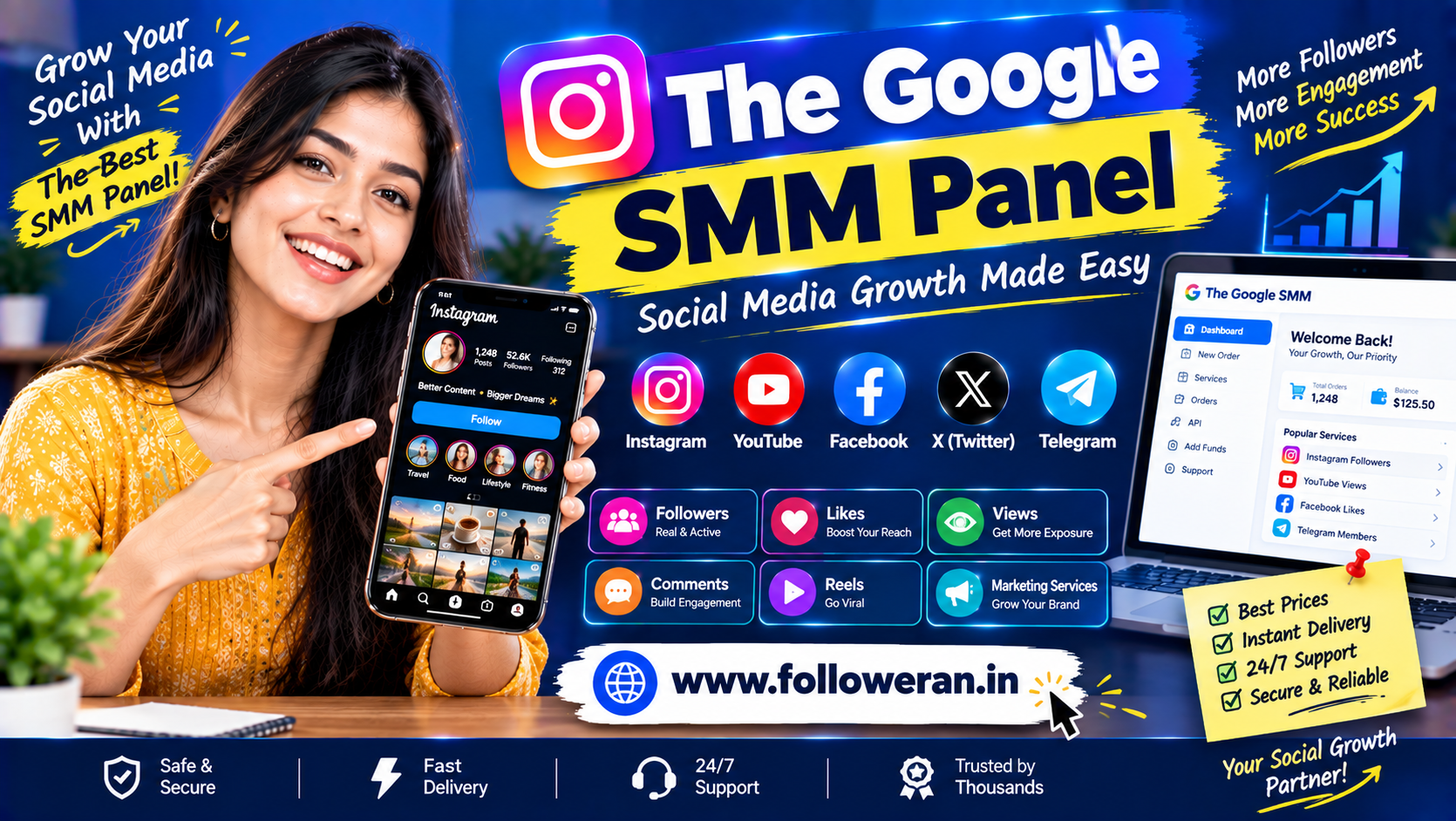
The Google SMM Panel: What It Is, How It Works, Services, API and Safety
The keyword “the Google SMM panel” can be confusing because it sounds like an official Google service. In practice, the phrase is also associated with a separate SMM-panel website called The Google SMM, which markets social-media services such as Instagram, YouTube, Facebook, Telegram and X-related services. Its public website describes itself as an SMM panel rather than as a Google-owned product.
This distinction is important.
Google is a technology company and search platform.
The Google SMM is a third-party SMM service brand.
They should not be treated as the same business.
This guide explains what the term means, how such a panel works, what to look for in its service catalogue and API, how resellers can evaluate it, and which risks should be considered before placing an order or adding funds.
What Is the Google SMM Panel?
The term can refer to The Google SMM, a third-party social-media marketing panel.
Its public site describes the platform as an SMM panel for resellers and individual users and lists social platforms including:
Instagram
YouTube
Facebook
Telegram
X/Twitter
The website also promotes itself using terms such as cheap SMM services and reseller-oriented functionality.
It is therefore better understood as:
A third-party SMM panel
rather than:
An official Google marketing product
Is The Google SMM Owned by Google?
There is no evidence in the public material reviewed that the SMM-panel website is an official Google service.
The website is operated under its own domain and presents itself as an independent SMM panel.
This matters because using the word Google in a business or domain name does not establish ownership or endorsement by Google.
Users should avoid assuming an affiliation simply because a service name contains a major brand name.
How Does The Google SMM Panel Work?
The basic SMM-panel workflow is straightforward.
Select a service
↓
Enter the target
↓
Choose quantity
↓
Place the order
↓
Provider processes the order
↓
Track status
For example, a reseller may select an Instagram service, enter the relevant profile or post URL, specify the quantity and submit the order.
The panel then handles the order through its underlying provider infrastructure.
What Services Can an SMM Panel Offer?
Service availability changes over time, but typical categories include:
Followers
Likes
Views
Comments
Reel-related services
YouTube
Views
Subscribers
Likes
Other channel-related services
Followers
Likes
Post engagement
Other supported services
Telegram
Members
Views
Other channel-related services
X/Twitter
Followers
Likes
Views
The actual service catalogue should always be checked directly before ordering.
What Is the SMM Panel API?
The API allows software to communicate with the panel automatically.
The public API documentation for The Google SMM specifies:
HTTP method: POST
API URL:
Response format: JSON
Its documented service-list action is:
action = servicesThe example service response contains fields including:
servicenametypecategoryrateminmaxdescrefill
The documentation also describes order-related API operations.
Why Is API Access Important?
API access is especially useful for SMM resellers.
Without an API:
Customer order → Manual provider order
With an API:
Customer order → Your website → Provider API → Automatic order
This can reduce manual work significantly.
An agency or reseller can therefore operate its own branded interface while using an upstream SMM service provider for fulfilment.
Are the Example Service IDs Live?
Not necessarily.
This is an important technical distinction.
API documentation often uses:
Service 1
Service 2
as examples.
You should not assume that an example ID is a live production service with the advertised price.
Before integrating the API, fetch the current service catalogue from the authenticated account and map the returned IDs into your own database.
How Should a Reseller Store Service IDs?
Suppose your website creates:
Internal Service ID = 101
The provider currently uses:
Provider Service ID = 4501
Store both.
| Field | Example |
|---|---|
| Internal ID | 101 |
| Provider ID | 4501 |
| Service | Instagram Followers |
| Rate | Provider value |
| Minimum | Provider value |
| Maximum | Provider value |
| Refill | Yes/No |
| Status | Active |
This allows your customer-facing website to remain stable even if provider service IDs change.
How Does an SMM Reseller Use the Panel?
A reseller can build this workflow:
Customer
↓
Your SMM Website
↓
Your Backend
↓
The Google SMM API
↓
Provider
↓
Order Status
↓
Your Customer Dashboard
The reseller can add a markup to the provider cost.
For example:
Provider cost: ₹100
Retail price: ₹150
Gross difference: ₹50
Actual profit will be lower after payment fees, refunds, support, software, taxes and other operating costs.
What Should Resellers Check Before Using an API?
Before integrating, verify:
Service endpoint
Can you retrieve the complete current catalogue?
Order endpoint
Can your software place an order programmatically?
Status endpoint
Can you track orders?
Balance endpoint
Can your backend monitor provider funds?
Error handling
Does the API return usable errors?
Authentication
How are API keys generated and protected?
Refill
Is refill supported through the API?
Cancellation
Is cancellation available for supported services?
These capabilities can vary from one provider to another.
API Security
Your API key should be treated like a password.
Never put it into:
Frontend JavaScript
Public HTML
Mobile app code without protection
Public Git repositories
A safer architecture is:
Customer Browser
      ↓
Your Backend
      ↓
Private API Key
      ↓
SMM Provider
The customer should never directly receive your provider credentials.
What Does an SMM Panel Cost?
SMM pricing can vary considerably by service.
A follower service may cost more than a view service.
A targeted service may cost more than a broad service.
A refill-supported service may cost more than a no-refill service.
The correct comparison is therefore:
Service + quantity + quality + retention + refill + delivery + support
rather than simply:
Price per 1,000
Why the Cheapest Service May Not Be the Best
Consider two providers.
| Factor | Provider A | Provider B |
|---|---|---|
| Cost / 1K | ₹20 | ₹30 |
| Refill | No | Yes |
| Support | Limited | Better |
| Delivery | Variable | More consistent |
| Failure rate | Higher | Lower |
Provider A is cheaper.
But Provider B could be more profitable for a reseller if it creates fewer refunds and support problems.
How to Evaluate Service Quality
Before scaling a service, place a small test order.
Record:
Start time
Completion time
Delivered quantity
Retention
Refill performance
Support response
Actual cost
Then compare those results against alternative providers.
This gives you a more useful picture than relying solely on promotional claims.
What About Refunds?
Refund handling depends on the service and provider.
Possible scenarios include:
Failed order
An order cannot be delivered.
Partial order
Only part of the requested quantity is delivered.
Cancelled order
The order is cancelled before completion.
Provider error
A technical issue prevents delivery.
Wrong target
The customer supplied an incorrect URL or account.
A reseller should understand how each condition is handled before selling the service.
What Is a Partial Order?
Suppose the customer requests:
10,000
but the provider delivers:
7,500
The order may become:
Partial
The reseller should determine what happens to the remaining 2,500 units according to the provider's policy.
Do not automatically promise a full refund unless the provider terms actually support it.
What Is a Refill?
A refill generally means replacing a qualifying quantity that has dropped after delivery.
For example:
Original order: 5,000
↓
Delivered: 5,000
↓
Later quantity drops
↓
Eligible refill
The exact refill period and conditions depend on the service.
Some API catalogues expose a refill field directly in the service response, as The Google SMM's public API example does.
Does Refill Mean Permanent Results?
No.
A refill period is not necessarily a guarantee of permanent retention.
For example:
30-day refill
does not mean:
Permanent followers forever
The service description should always be read carefully.
What Payment Methods Should Indian Resellers Look For?
An Indian reseller may prefer:
UPI
Cards
Bank transfer
INR-friendly payment options
Other supported payment methods
International providers may also offer:
PayPal
Cryptocurrency
International cards
The best payment setup depends on where your customers are located and which methods your payment provider supports.
Is The Google SMM Suitable for Indian Resellers?
The answer depends on your requirements.
Before committing, Indian resellers should compare:
INR/payment convenience
API
Service pricing
Service variety
Refill
Support
Order reliability
Refund handling
A panel can be suitable on one criterion and unsuitable on another.
What About “Google” Services?
This is where extra caution is necessary.
Someone searching for the Google SMM panel might actually be looking for:
Google reviews
Google Business Profile services
Google traffic
Google search rankings
or:
YouTube services
These are not interchangeable.
An SMM panel cannot control Google's search rankings simply by selling social-media metrics.
Likewise, artificial Google reviews can create serious trust and policy concerns.
Google Reviews Are Different From Social-Media Metrics
A Facebook like and a Google customer review are fundamentally different.
A genuine review should come from a real customer describing a real experience.
A business should not assume that buying reviews is equivalent to legitimate reputation management.
If a service claims to guarantee Google reviews or search rankings, evaluate the offer very carefully.
Can an SMM Panel Improve Google Rankings?
There is no automatic rule that buying social-media metrics will make a website rank higher in Google.
SEO involves many factors, including:
Content
Search relevance
Technical quality
Internal linking
External authority
User experience
Search intent
An SMM panel should not be presented as a guaranteed Google-ranking solution.
The Google SMM vs Google Ads
These are completely different.
The Google SMM
A third-party SMM panel brand.
Google Ads
Google's advertising platform.
Google Ads allows businesses to pay for advertising placements through Google's advertising ecosystem.
A third-party SMM panel does not become Google Ads simply because its brand name contains “Google.”
The Google SMM vs Google Search
Google Search is a search engine.
The Google SMM is an SMM service platform.
They serve different purposes.
A customer looking for:
SEO
may need an SEO strategy.
A customer looking for:
Google Ads
may need paid search advertising.
A customer looking for:
Instagram likes or followers
may be looking for an SMM service.
Understanding the difference prevents people from buying the wrong service.
Is The Google SMM a Good Panel?
There is no responsible way to answer this with a universal yes or no based only on the name.
A useful evaluation should consider:
Current service quality
Current pricing
API reliability
Support
Refund handling
Refill performance
Payment convenience
Security
Actual test orders
Publicly available information can confirm that The Google SMM has an SMM-panel website and public API documentation, but that alone does not establish that every service is consistently high quality.
How to Test the Panel Before Scaling
Use a controlled test.
Test 1: Create an account
Check registration and dashboard usability.
Test 2: Review services
Look for clear descriptions and limits.
Test 3: Add a small balance
Avoid committing large funds immediately.
Test 4: Place a small order
Track the complete workflow.
Test 5: Check status
Confirm that status updates work correctly.
Test 6: Contact support
Ask a normal technical question.
Test 7: Evaluate retention
Where applicable, observe what happens after completion.
This gives you real operating data.
A Useful SMM Panel Scorecard
Score each provider from 1 to 10.
| Category | Score |
|---|---|
| Pricing | /10 |
| Service quality | /10 |
| Delivery | /10 |
| Retention | /10 |
| Refill | /10 |
| API | /10 |
| Support | /10 |
| Payments | /10 |
| Refund handling | /10 |
| Security | /10 |
Then compare multiple suppliers.
This is more useful than choosing based on a “cheapest panel” claim.
Common Mistakes When Using an SMM Panel
Choosing by price only
Low cost does not guarantee high value.
Ordering large quantities immediately
Always test first.
Ignoring refill conditions
A service may not include refill.
Giving your social-media password
A normal SMM API should not require you to expose your password simply to place an ordinary service order.
Exposing your API key
Keep credentials server-side.
Assuming all service IDs are permanent
Provider catalogues can change.
Treating examples as live data
API documentation often contains dummy values.
Confusing social services with SEO
Social metrics do not guarantee Google rankings.
Is an SMM Panel Safe?
Safety depends on the exact service and how it is used.
Potential concerns include:
Account security
Artificial engagement
Poor audience quality
Platform-policy violations
Payment disputes
Provider reliability
Data exposure
For important business accounts, evaluate the risk before using any third-party service.
How to Protect Your Social Accounts
Never give an unknown provider:
Password
Two-factor authentication code
Recovery code
or other sensitive credentials simply to purchase a standard service.
Use legitimate API integrations where available and keep your account-security information private.
Alternatives to Buying Social Metrics
If your actual objective is audience growth, consider:
Organic content
Create useful and entertaining posts.
Paid advertising
Target relevant audiences through official advertising systems.
Influencer collaborations
Reach an established niche audience.
SEO
Capture people actively searching for your products or services.
Community building
Develop genuine long-term relationships.
These methods can take longer, but they can create more meaningful business value.
Who Should Consider an SMM Panel?
SMM panels may be relevant to:
SMM resellers
Digital agencies
Freelancers
Creators
Businesses testing promotional services
The appropriate service depends on the use case.
A reseller may care about API and margins.
A creator may care about small minimum orders.
An agency may care about reliability and bulk processing.
A business may care about leads and sales.
Who Should Be Especially Careful?
Extra caution is appropriate for:
Monetised YouTube channels
Major business accounts
Professional profiles
Heavily regulated businesses
Brands dependent on reputation
Accounts with valuable communities
For these users, platform-policy and reputation considerations can outweigh a low service price.
Frequently Asked Questions
What is the Google SMM panel?
The phrase can refer to The Google SMM, a third-party SMM-panel website offering social-media services. It is not the same thing as an official Google product.
Is The Google SMM owned by Google?
The public information reviewed does not establish that it is owned or operated by Google. It operates as a separate SMM-panel website under thegooglesmm.com.
Does The Google SMM have an API?
Yes. Its public documentation describes a POST API at https://thegooglesmm.com/api/v2 and documents actions including retrieving services and placing or monitoring orders.
What platforms does The Google SMM support?
Its public material mentions services for platforms including Instagram, YouTube, Facebook, Telegram and X/Twitter. The exact current catalogue should be checked before ordering.
Are the service IDs in the API documentation live?
You should not assume that example IDs are live production services. Fetch the current authenticated service list before integrating or placing orders.
Can an SMM reseller use The Google SMM API?
An API can be used for automated reseller workflows where the provider account and API terms support that use. The developer should securely store the API key and map provider service IDs into the reseller's own database.
Is the cheapest SMM panel always the best?
No. Delivery quality, retention, refill, support, API reliability and refund handling can be more important than price alone.
Can an SMM panel improve Google rankings?
There is no automatic guarantee that purchasing social-media metrics will improve Google search rankings. SEO requires a broader strategy.
Is Google SMM the same as Google Ads?
No. Google Ads is Google's advertising platform, while The Google SMM is a separate third-party SMM-panel brand.
Should I test an SMM panel before depositing a large amount?
Yes. A small test can help evaluate service quality, delivery, support, API behaviour and refund/refill handling before you scale.
Final Thoughts
The keyword “the Google SMM panel” can create confusion because of the word “Google.”
The important distinction is:
The Google SMM = a third-party SMM-panel brand
Google = the technology/search/advertising company
The Google SMM's public documentation shows an SMM API with a /api/v2 structure, JSON responses and service/order functionality, making it relevant for developers and resellers looking for automated fulfilment.
But an API and a large service catalogue do not automatically make a panel the best choice.
Before using any provider, compare:
Price
Service quality
Delivery
Retention
Refill
Refund handling
API reliability
Payment options
Support
Security
Most importantly, test the services you actually intend to sell.
And if your real goal is Google SEO, Google Ads, Google Business visibility or genuine customer reviews, make sure you are choosing the correct marketing solution rather than assuming that an SMM panel can perform all of those functions.
For an SMM reseller, the strongest long-term approach is to combine reliable fulfilment infrastructure with SEO, content marketing, legitimate advertising, strong customer support and transparent service policies.
