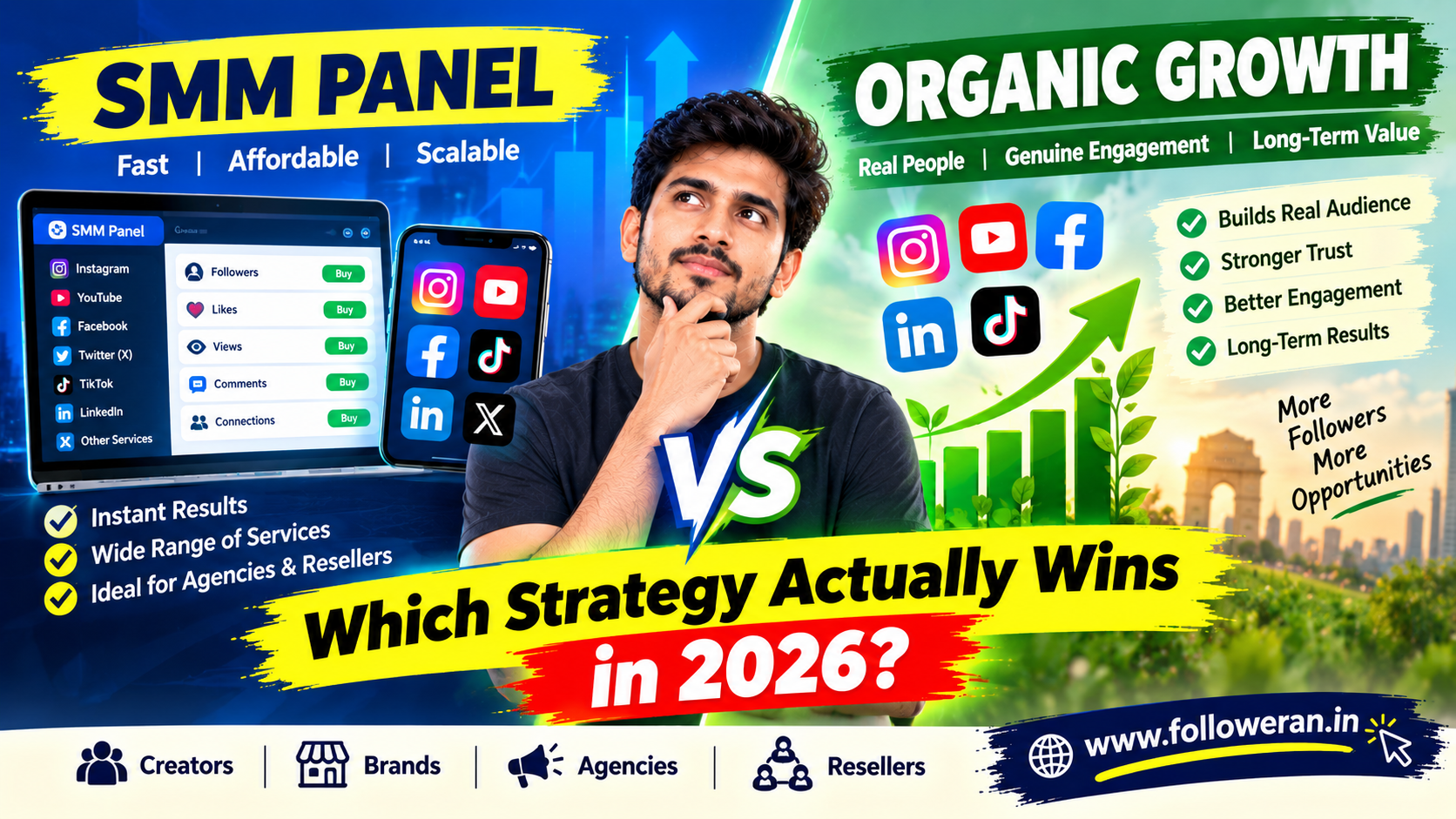
SMM Panel vs Organic Growth: Which Strategy Actually Wins in 2026?
The SMM Panel vs Organic Growth debate is still relevant in 2026, particularly in India, where creators, small businesses, agencies and resellers are competing for attention across Instagram, YouTube, Facebook, LinkedIn, TikTok and other social platforms.
At first glance, the choice seems simple.
An SMM panel can provide access to social-media promotional services through a dashboard, while organic growth relies on content, audience interaction, search and consistent publishing.
But these approaches solve different problems.
An SMM panel is primarily a service-delivery and marketing tool. Organic growth is a long-term audience-building strategy.
The right choice depends on what you are trying to achieve, how quickly you need results, how much operational work you can handle, and how important genuine audience relationships are to your business.
There is also an important risk consideration in 2026. Major platforms actively detect and restrict artificial or inauthentic activity. YouTube, for example, prohibits artificial inflation of views, likes, comments and subscribers, while LinkedIn prohibits fake engagement and unauthorized automated activity. (Google Help)
So which strategy actually wins?
For most serious Indian businesses and creators, organic growth should be the foundation, while legitimate paid promotion and carefully selected marketing tools can support that foundation.
What Is an SMM Panel?
An SMM panel is an online platform where users can browse and order social-media marketing services.
Depending on the provider, the catalogue may include:
Followers
Likes
Views
Subscribers
Comments
Impressions
Engagement-related services
Social-media marketing packages
API-based services for resellers
The basic process is usually:
Choose service → Enter required link/details → Select quantity → Place order → Track delivery
For agencies and resellers, APIs can make the process more scalable by allowing orders to flow from a customer's system into the provider's infrastructure.
However, an SMM panel should not be confused with organic audience development.
A purchased metric is not automatically equivalent to a genuine customer, fan, subscriber or professional connection.
What Is Organic Social Media Growth?
Organic growth means building an audience without purchasing artificial engagement.
It can include:
Reels and short-form videos
YouTube videos and Shorts
Educational posts
Search-optimised social content
Community participation
Creator collaborations
Influencer partnerships
Consistent posting
Genuine comments and conversations
Email and website traffic
Word-of-mouth referrals
Search discovery
Organic growth is usually slower at the beginning, but it is designed to build a genuine relationship between the account and its audience.
SMM Panel vs Organic Growth at a Glance
| Factor | SMM Panel | Organic Growth |
|---|---|---|
| Initial speed | Usually faster | Usually slower |
| Financial cost | Direct service cost | Mainly time, content and production cost |
| Scalability | High | Moderate to high |
| Audience quality | Varies by service | Usually higher when executed well |
| Relationship building | Limited | Strong |
| Content requirement | Still necessary | Essential |
| Long-term value | Depends on service and use | Generally strong |
| Platform-policy risk | Can be significant for artificial engagement | Lower when methods are legitimate |
| Agency use | High potential for fulfilment/reselling | High for strategy and content |
| Reseller use | Central to many reseller models | Less relevant operationally |
| Lead generation | Not guaranteed | Can be strong when content matches buyer intent |
| Brand credibility | Depends on audience quality | Usually stronger over time |
There is no universal winner for every use case.
Which Is Faster?
This is where SMM panels appear attractive.
An organic account may need weeks or months of consistent content before gaining significant momentum.
A panel order, by comparison, can be processed much faster depending on the service.
But speed needs context.
Fast delivery of a metric does not mean fast delivery of:
Customers
Sales
Trust
Brand awareness
Community
Business relationships
For example, 5,000 additional followers do not automatically mean 5,000 potential buyers.
That distinction is extremely important when evaluating ROI.
Which Is Cheaper?
The answer depends on what you count as a cost.
Organic growth is often described as “free”, but professional organic growth can involve considerable expenses.
A brand may need:
Content creators
Designers
Video editors
Cameras and equipment
Social-media managers
Copywriters
Strategy
Influencer collaborations
Community managers
An SMM panel has a clearer direct cost because the service itself has a listed price.
That makes panel-based services attractive to agencies and resellers that need predictable fulfilment costs.
But cheap does not necessarily mean cost-effective.
A low-cost service that produces poor-quality activity can have little business value.
The Real Difference: Vanity Metrics vs Business Outcomes
Consider two Instagram accounts.
Account A
50,000 followers
Low engagement
Few enquiries
Very little website traffic
Account B
7,500 followers
Strong engagement
Regular enquiries
Multiple customer conversations
For a business, Account B may be considerably more valuable.
This is why you should measure:
Leads + Sales + Engagement + Reach + Audience Quality
rather than looking only at follower count.
When Organic Growth Wins
Organic growth is particularly strong when trust matters.
Personal brands
Consultants, coaches, professionals and experts need credibility.
Their audience needs to believe that the person actually knows what they are talking about.
B2B businesses
B2B buying decisions can involve weeks or months of consideration.
A real content strategy can help demonstrate expertise.
Creators
Creators need viewers who repeatedly watch their content.
A large number of inactive or irrelevant followers does not solve this problem.
Local businesses
Restaurants, salons, gyms, clinics, interior designers and other local businesses ultimately need customers rather than follower numbers.
Long-term brands
A company building a durable brand usually benefits from a genuine community and recognisable identity.
When an SMM Panel Can Be Useful
There are legitimate operational situations in which a panel can be useful, particularly for agencies and resellers.
Agencies managing multiple services
An agency may need a central dashboard for service fulfilment and order tracking.
Resellers
SMM resellers can use provider APIs and wholesale pricing to create their own packages and manage customer orders.
Operational testing
A reseller can test provider reliability, service descriptions, pricing and fulfilment before committing to larger workflows.
Reporting and fulfilment
For a service business, centralised ordering can simplify operational processes.
That is very different from claiming that purchased engagement will replace an actual marketing strategy.
What About Social Proof?
This is one of the most common arguments for SMM services.
A brand-new account with zero followers can look undeveloped.
However, social proof is only useful when it is credible.
A large audience with little corresponding engagement can create the opposite impression.
Real social proof is stronger when it comes from:
Genuine customer reviews
Real comments
Community interaction
Creator mentions
Case studies
User-generated content
Real subscribers
Professional partnerships
Important Platform Risks in 2026
This is where the comparison becomes especially important.
YouTube
YouTube explicitly prohibits artificially increasing views, likes, comments or other metrics. It also says artificial traffic may not be counted and policy violations can lead to strikes or channel termination. (Google Help)
For monetised channels, YouTube also warns creators not to artificially inflate views, subscribers, likes, watch time or ad impressions. (Google Help)
LinkedIn does not permit fake engagement or tools that manipulate its content algorithms. It also restricts unauthorized automated activity and fake accounts. (LinkedIn)
LinkedIn says excessive or automated activity can lead to reduced visibility or account restrictions. (LinkedIn)
General lesson
Before purchasing any social-media service, check the current rules of the specific platform involved.
Do not assume that a service being publicly available means the platform permits its use.
SMM Panel vs Organic Growth for Indian Creators
Indian creators often operate with limited budgets but need to compete with established accounts.
A practical creator strategy is:
Content first → audience research → organic distribution → legitimate promotion → analytics
Focus on producing content people voluntarily choose to watch.
Use analytics to determine:
Which videos get the most reach
Which topics bring profile visits
Which posts generate shares
Which content generates followers
Which audiences watch longest
A creator should not confuse the number of followers with the number of actual fans.
SMM Panel vs Organic Growth for Indian Brands
For brands, the objective should normally be business growth.
A restaurant may care about reservations.
A salon may care about appointments.
A real-estate company may care about property enquiries.
An online store may care about purchases.
Therefore the social-media strategy should connect activity to a business outcome.
A useful funnel is:
Content → Reach → Profile visit → Website/WhatsApp → Enquiry → Customer
A follower count that does not contribute to this funnel has limited commercial value.
SMM Panel vs Organic Growth for Agencies
Agencies have a different perspective.
They need:
Reliable suppliers
Predictable pricing
Service variety
Order management
API access
Reporting
Customer support
Margins
Scalable fulfilment
This is where SMM panels can have substantial operational value.
An agency may use a panel as part of the backend fulfilment layer while independently handling strategy, creative work, advertising, analytics and client communication.
However, the agency should disclose what it is selling and avoid making unrealistic performance promises.
SMM Panel vs Organic Growth for Resellers
Resellers are generally more interested in infrastructure than individual campaign results.
For example, a reseller may need:
Provider → API → Reseller Panel → Customer → Order → Delivery → Reporting
In that environment, an SMM panel can be highly useful.
The key business metrics become:
Wholesale cost
Retail price
Profit margin
API reliability
Service availability
Failed-order rate
Refill/refund handling
Support response
Customer retention
Organic growth, meanwhile, is more relevant to the reseller's own brand and customer acquisition.
The Best Strategy for SMM Resellers
A reseller should build two systems.
System 1: Fulfilment
Use appropriate panel infrastructure to handle orders and services.
System 2: Acquisition
Use:
SEO
Google Ads
Social content
YouTube
Blogs
WhatsApp marketing
Email
Partnerships
Affiliate marketing
The second system brings customers.
The first system serves them.
Confusing the two is a common business mistake.
What About SMM Panels and SEO?
SMM panels and SEO are fundamentally different.
SEO attempts to increase visibility through search relevance, useful content, technical optimisation and authority.
Buying social metrics does not replace:
Keyword research
Content
Internal linking
Technical SEO
Page experience
Search intent
Topical authority
For an SMM panel business, SEO is often one of the most valuable acquisition channels because users actively search for terms such as:
Best SMM panel
Cheap SMM panel
SMM panel India
Instagram SMM panel
YouTube SMM panel
SMM panel API
SMM reseller panel
Organic Growth Is Not Always “Free”
This is an important misconception.
Suppose a business spends:
₹20,000 on content
₹10,000 on editing
₹15,000 on management
That is ₹45,000 in monthly operating cost.
Even though the business has not directly purchased followers, organic growth is not free.
The currency is often time, labour and content production.
That does not make organic growth bad.
It simply means the comparison should be based on total cost rather than marketing terminology.
A Better Way to Compare ROI
Instead of calculating:
Cost per follower
calculate:
Cost per qualified lead
or:
Cost per customer
For example:
Strategy A
₹10,000 spent
1,000 additional followers
0 customers
Strategy B
₹10,000 spent
300 additional followers
15 qualified enquiries
3 customers
For a commercial business, Strategy B could easily be the better investment.
Should You Choose One or Combine Both?
For most serious businesses, a hybrid approach can make more sense than treating the strategies as enemies.
The combination might look like:
Organic content + legitimate advertising + analytics + operational tools
This puts organic growth at the centre while using paid channels and infrastructure where they provide real value.
However, a hybrid strategy does not mean artificially inflating every metric.
The objective should be sustainable growth, not simply a larger dashboard number.
2026 Strategy for Indian Creators
A creator could allocate effort approximately like this:
60% Content
Create high-quality, relevant videos and posts.
20% Community
Reply to comments, build relationships and collaborate.
10% Analytics
Study what works.
10% Promotion
Use legitimate promotional channels where appropriate.
The exact percentages are flexible.
The principle is more important:
Create something worth discovering before spending money to distribute it.
2026 Strategy for Indian Brands
Brands can use a similar framework:
Content → Organic discovery → Paid amplification → Lead capture → Retargeting → Conversion
This can work particularly well for businesses with measurable customer journeys.
The social-media account becomes part of the wider marketing funnel rather than the entire marketing strategy.
2026 Strategy for Agencies
Agencies should separate:
Strategy
from
Execution
and
Fulfilment
The client should understand what they are paying for.
For example:
Strategy = ₹X
Content = ₹X
Management = ₹X
Advertising management = ₹X
Ad spend = separate
Optional third-party services = clearly disclosed
Transparent packaging makes your agency easier to trust.
How to Choose Between SMM Panel and Organic Growth
Ask five questions.
What is my objective?
Followers, awareness, leads, sales, professional networking or reseller fulfilment?
How quickly do I need results?
A launch campaign may have different requirements from a two-year brand strategy.
How important is audience quality?
For a creator or local business, audience relevance is extremely important.
What level of platform risk can I accept?
Creators relying on monetisation or professional reputation should be especially conservative.
What can I measure?
If you cannot connect an activity to a meaningful outcome, reconsider whether it deserves your budget.
Final Scorecard
| Goal | Better Starting Point |
|---|---|
| Build a personal brand | Organic |
| Build a creator community | Organic |
| Generate local-business leads | Organic + legitimate advertising |
| Establish thought leadership | Organic |
| Manage reseller fulfilment | SMM panel infrastructure |
| Run an SMM agency | Hybrid |
| Build long-term brand trust | Organic |
| Test service fulfilment | SMM panel |
| Build a reseller business | Panel + SEO + acquisition |
| Create sustainable audience growth | Organic |
Frequently Asked Questions
Is an SMM panel better than organic growth in 2026?
Not universally. An SMM panel and organic growth solve different problems. Organic growth is generally stronger for building genuine audiences, while panel infrastructure can be useful for service fulfilment and reseller operations.
Which is cheaper: SMM panels or organic growth?
SMM panels can have a lower direct cost for specific services, but organic growth also has labour and content-production costs. Compare the total cost against the business outcome rather than comparing follower prices alone.
Is organic Instagram growth still worth it in 2026?
Yes. Organic growth remains valuable for creators and brands because it builds genuine audience relationships and content-driven discovery.
Can an SMM panel replace content marketing?
No. Even if a business uses third-party services, it still needs valuable content to build trust, attract the right audience and generate meaningful engagement.
Are SMM panels safe in 2026?
Safety depends on the service, platform and method. Artificial engagement and unauthorized automation can violate platform policies. YouTube and LinkedIn, for example, explicitly prohibit forms of artificial or inauthentic activity. (Google Help)
Should agencies use SMM panels?
Agencies may use panel infrastructure for fulfilment, especially where reseller services and APIs are involved. However, they should keep client expectations realistic and distinguish fulfilment services from genuine marketing outcomes.
What should Indian resellers focus on in 2026?
Resellers should focus on reliable fulfilment, competitive pricing, API stability, customer support, SEO, lead generation and transparent service descriptions.
Final Verdict: Which Strategy Actually Wins?
The winner is not simply SMM panel or organic growth.
For an Indian creator, brand or local business, organic growth is usually the stronger foundation because it builds real attention, trust and relationships.
For an agency or reseller, an SMM panel can be valuable as operational infrastructure, especially when it provides scalable ordering, service management and API capabilities.
The smartest 2026 strategy is therefore:
Build organically. Promote legitimately. Measure business outcomes. Use panel infrastructure where it solves an operational problem.
Do not judge your social-media strategy by follower count alone.
Judge it by whether the right people discover you, trust you, engage with you and eventually take the action your business actually needs.
