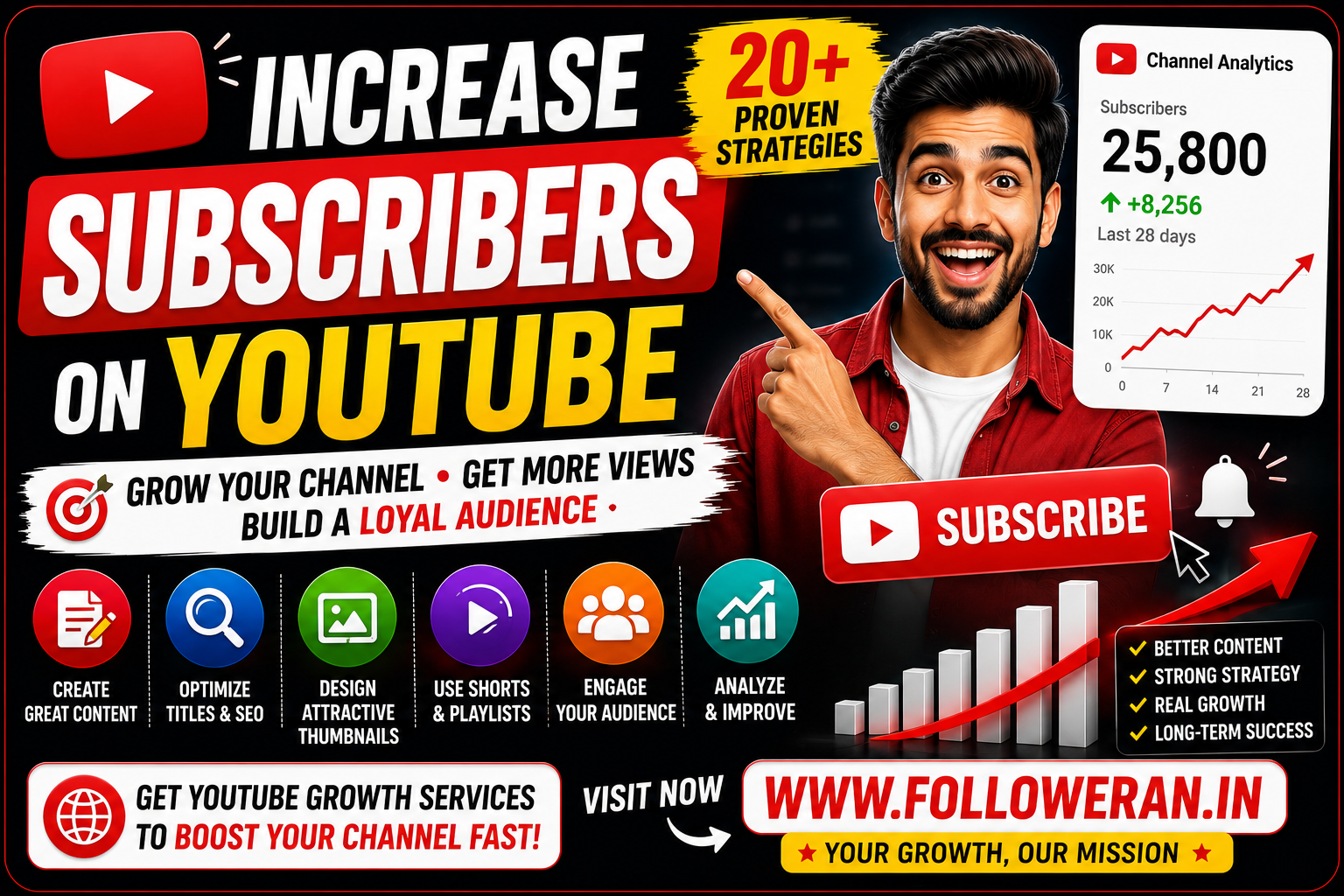
Increase Subscribers on YouTube: 20 Proven Ways to Grow Your Channel
If you're searching for increase subscribers on YouTube, you're probably looking for practical ways to get more people to discover your channel, watch your videos and subscribe.
The good news is that YouTube growth isn't simply about uploading as many videos as possible.
YouTube's current guidance emphasises understanding your audience, creating content they want to watch, packaging videos with effective titles and thumbnails, and maintaining viewer satisfaction throughout the video. YouTube describes recommendation performance through three broad areas: appeal, engagement and satisfaction.
That means subscriber growth is usually a result of getting the right viewers to:
Discover your video → click → watch → enjoy → return → subscribe
This guide explains how to increase subscribers on YouTube with practical strategies for both new and established channels.
Why YouTube Subscribers Matter
Subscribers can help create a returning audience, but subscriber count isn't the same thing as your active audience size.
YouTube notes that a channel's subscriber count reflects the number of times people have subscribed, while Unique Viewers can provide a clearer picture of the current active audience.
Subscribers can still be valuable because they indicate that viewers have chosen to stay connected with your channel.
However, the real objective should be to build an audience that continues to watch and enjoy your content.
What Actually Helps Increase YouTube Subscribers?
A useful way to think about subscriber growth is:
Topic → Packaging → Click → Retention → Satisfaction → Subscription
Let's break that down.
1. Choose a Clear Channel Niche
One of the easiest ways to confuse potential viewers is to publish completely unrelated content.
A focused channel makes it easier for viewers to understand what they can expect from you.
Possible niches include:
- Digital marketing
- Gaming
- Fitness
- Technology
- Education
- Travel
- Food
- Finance
- Photography
- Home improvement
- News and commentary
- Tutorials
You don't have to cover only one tiny subject, but your content should have a recognisable theme.
2. Understand What Your Audience Wants
Don't choose topics only because you personally like them.
Study what your viewers are already watching.
YouTube's Audience analytics can show what content your viewers watch outside your channel, helping you identify subjects, formats and potential collaboration opportunities.
Ask:
What problems does my audience have?
What questions do they search for?
What videos do they watch repeatedly?
What topics are competitors covering successfully?
Then use those insights to generate ideas.
3. Create Videos Around Specific Problems
Broad topics can be difficult to package.
Compare:
“Digital Marketing”
with:
“How to Create a Google Ads Campaign for a Local Business”
The second topic gives viewers a much clearer reason to click.
Useful YouTube videos often answer a specific question, solve a problem or satisfy a clear interest.
4. Write Better YouTube Titles
Your title is one of the first things viewers see.
YouTube specifically identifies titles and thumbnails as important elements of how content is packaged and presented to viewers.
A strong title should:
- Clearly describe the video
- Match viewer intent
- Create curiosity where appropriate
- Avoid misleading claims
- Make the benefit understandable
Example
Weak:
YouTube Tips
Better:
10 YouTube Mistakes Stopping Your Channel From Growing
The second title gives the viewer a clearer reason to watch.
5. Improve Your Thumbnails
A thumbnail should communicate the video's value quickly.
YouTube recommends thumbnails and titles that accurately represent the content and warns against deceptive or misleading packaging.
Good thumbnails often use:
- One clear visual idea
- Large readable text
- Strong contrast
- A recognisable subject
- Simple composition
- Visual curiosity
Avoid overcrowding the thumbnail with long paragraphs.
6. Make the First 30 Seconds Count
The beginning of your video matters.
YouTube's audience-retention guidance specifically tracks how many viewers remain after the first 30 seconds and recommends making sure the opening matches the expectation set by the title and thumbnail.
Avoid spending the first 30 seconds on a long introduction.
Get to the value quickly.
For example:
“In this video, I'll show you five ways to increase YouTube subscribers without relying on clickbait.”
Then start delivering the information.
7. Deliver the Promise of the Title
A common mistake is creating a strong title and thumbnail but delaying the promised information.
Suppose your title says:
“How to Get More YouTube Subscribers”
Don't spend several minutes talking about your personal history before discussing subscriber growth.
YouTube recommends ensuring that your intro delivers on the promise made by the title and thumbnail.
8. Focus on Viewer Satisfaction
Views are important, but getting people to watch isn't enough.
YouTube says recommendation systems consider whether viewers choose to watch, whether they stay engaged and whether they appear satisfied with the content.
This is why you should ask:
“Would my target viewer genuinely feel that this video was worth their time?”
That question is more useful than trying to guess what will “trick the algorithm.”
9. Don't Make Videos Longer Just to Make Them Longer
There is no universal ideal YouTube video length.
YouTube explicitly says there is no optimal length that works for every video. Instead, creators should make the video as long as necessary to deliver value without unnecessary filler.
A useful 6-minute tutorial is better than an 18-minute video padded with repetition.
Likewise, an in-depth 25-minute subject shouldn't be forced into five minutes simply to chase a shorter duration.
10. Use YouTube Shorts Strategically
Shorts can introduce your content to new viewers.
YouTube's recommendation system operates across formats including Shorts, long-form videos and live streams, and YouTube encourages creators to experiment with different formats to learn what fits their audience.
You can use Shorts for:
- Quick tips
- Highlights
- Mini tutorials
- FAQs
- Reactions
- Before-and-after examples
- Short educational content
- Clips from longer videos
The key is relevance.
A Short should attract people who may also be interested in your longer content or channel topic.
11. Create Series Instead of Isolated Videos
A series can give viewers a reason to watch another video after finishing one.
For example:
Part 1: YouTube Channel Setup
Part 2: YouTube Branding
Part 3: YouTube SEO
Part 4: YouTube Thumbnail Strategy
Part 5: YouTube Analytics
This creates a natural content journey.
YouTube also recommends making it easier for viewers to discover more of your content through tools such as playlists, end screens and clear calls to action.
12. Use Playlists Properly
Playlists can group related videos into a clear viewing path.
Examples:
- YouTube Beginner Tutorials
- SEO Training
- Google Ads Tutorials
- Instagram Marketing
- Digital Marketing Courses
A viewer who finishes one video can continue into another related video rather than leaving your channel.
13. Use End Screens
End screens can encourage viewers to watch another relevant video or subscribe.
Instead of ending abruptly, direct viewers to the next logical step.
For example:
“Now watch this video to learn how to improve your YouTube thumbnails.”
YouTube specifically recommends using end screens and other navigation tools to help viewers discover more of your content.
14. Ask People to Subscribe at the Right Moment
A subscription call to action can be useful when it feels relevant.
Instead of repeatedly saying:
“Please subscribe, please subscribe, please subscribe.”
try:
“If you're building a digital-marketing channel and this tutorial helped, subscribe for more practical guides.”
Make the request specific to the value you're providing.
15. Give Viewers a Reason to Subscribe
This is one of the most important points.
Don't just ask:
“Please subscribe.”
Explain why.
For example:
“Subscribe if you want weekly YouTube growth tutorials.”
or:
“Subscribe for new SEO tutorials every Tuesday.”
The viewer needs to know what they will receive in return.
16. Create Content Consistently
Consistency helps you build a sustainable publishing habit.
However, YouTube explicitly says quality is more important than simply increasing upload frequency and that taking breaks does not inherently result in an algorithmic penalty.
So don't publish poor-quality videos every day just to keep a schedule.
Choose a schedule you can realistically maintain.
For example:
1 high-quality long-form video per week
plus
2–3 Shorts
may be more sustainable than daily uploads.
17. Build a Recognisable Channel Brand
YouTube recommends clear and consistent presentation so viewers can quickly understand what a channel is about.
You can maintain consistency through:
- Thumbnail style
- Colours
- Fonts
- Intro structure
- Video format
- Voice and tone
- Topic categories
A recognisable visual identity can make your videos easier to identify.
18. Study Audience Retention
YouTube Analytics provides audience-retention data that shows where viewers stay, leave or rewatch parts of your content.
Look for:
- Early drop-offs
- Strong opening sections
- Moments with spikes
- Long sections with declining retention
- Frequently replayed sections
YouTube recommends examining these key moments and using them to improve future content.
If viewers consistently leave during a long introduction, shorten the introduction.
If viewers consistently engage with a particular section, consider creating more content around that subject.
19. Improve Weak Videos Through Better Packaging
Sometimes the content itself is good but the presentation isn't.
YouTube says changing a video's title or thumbnail can alter performance because viewers may respond differently to the new presentation.
That means you can test better packaging when a video isn't attracting enough interest.
However, don't keep changing something that is already performing well simply because you're chasing a higher number.
20. Use Analytics to Measure Your Own Progress
There is no universal “good” YouTube performance benchmark.
YouTube says creators should compare performance against their own historical results because benchmarks can vary significantly by topic and format.
Useful metrics include:
| Metric | What It Helps You Understand |
|---|---|
| Views | Reach |
| Impressions | Exposure |
| Click-through rate | Packaging response |
| Watch time | Viewer consumption |
| Audience retention | Where viewers stay or leave |
| Likes | Positive interaction |
| Comments | Conversation |
| Shares | Distribution |
| Subscribers gained | Conversion |
| Unique viewers | Approximate active audience size |
Don't judge your channel from one metric alone.
How to Increase Subscribers From Each Video
A useful framework is:
Step 1: Attract
Use a strong topic, title and thumbnail.
Step 2: Deliver
Give viewers the information promised.
Step 3: Engage
Keep the video interesting and useful.
Step 4: Connect
Show viewers why your channel is worth following.
Step 5: Continue
Send them to another relevant video.
This creates a content loop:
Video → Satisfaction → Subscribe → More Videos
How to Increase YouTube Subscribers for a New Channel
New channels face a simple challenge: nobody knows they exist yet.
Start with a focused content strategy.
Choose 3–5 Core Topics
For example, a digital-marketing channel could focus on:
- SEO
- Google Ads
- Social-media marketing
- Website optimisation
- Content marketing
Create a Content Library
YouTube notes that having a substantial library of high-quality content gives newly discovered viewers more opportunities to explore your channel and build a stronger connection with it.
Improve One Video at a Time
You don't need your first 50 videos to be perfect.
Learn from each one.
How to Increase YouTube Subscribers Without Buying Them
Organic growth is based on attracting viewers who genuinely want your content.
You can improve subscriber growth by:
- Solving specific problems
- Creating useful tutorials
- Making better thumbnails
- Writing stronger titles
- Improving retention
- Using Shorts strategically
- Building playlists
- Creating series
- Collaborating with relevant creators
- Studying Analytics
This builds a stronger relationship between your channel and its audience.
What About Buying YouTube Subscribers?
You may find third-party services that advertise subscriber packages.
However, purchased subscribers should not be treated as equivalent to genuinely interested viewers.
A subscriber who never watches your content provides limited audience value.
Before using any third-party social-media service, examine exactly what is being offered, along with delivery conditions, policies and security requirements.
Never give an unfamiliar provider your YouTube password, Google account password or authentication codes.
A subscriber number is useful only when it reflects an audience that has some genuine interest in what you publish.
How to Get Real YouTube Subscribers
If your goal is long-term channel growth, prioritise relevance.
Create videos for a specific type of viewer.
For example:
“Google Ads tutorials for small businesses in India”
is a clearer audience proposition than:
“Business tips.”
A clear audience makes it easier to produce content that consistently matches viewer expectations.
How to Increase Subscribers With YouTube Shorts
Shorts can be useful for discovery.
Try creating:
Quick Tips
“3 YouTube mistakes beginners make.”
Mini Tutorials
“How to add chapters to a YouTube video.”
Myth vs Fact
“Does posting every day guarantee YouTube growth?”
Before and After
Show the improvement from a weak thumbnail to a stronger one.
Clips
Turn valuable sections of long-form videos into Shorts.
The objective is not simply maximum Shorts views.
You want to attract viewers who are likely to be interested in your channel's wider content.
How to Increase Subscribers With Long-Form Videos
Long-form videos are useful when the topic requires depth.
Examples include:
- Tutorials
- Product reviews
- Interviews
- Case studies
- Courses
- Documentaries
- Detailed walkthroughs
Don't add filler simply to increase watch time.
YouTube explicitly recommends using the precise length needed to deliver value effectively.
How to Increase Subscribers With Collaboration
Collaborations can introduce your channel to viewers who already have an interest in your topic.
The best collaborations usually involve complementary audiences.
For example:
SEO creator + website designer
Fitness coach + nutrition creator
Travel creator + photography creator
Marketing consultant + small-business expert
YouTube's Audience analytics can also help identify channels your viewers watch, which may reveal relevant collaboration opportunities.
How to Increase YouTube Subscribers From Search
Search-oriented content can work particularly well for tutorial channels.
Create videos around specific questions people are likely to search.
Examples:
- How to create a YouTube channel
- How to edit YouTube videos
- How to add subtitles to YouTube
- How to make YouTube thumbnails
- How to get more views on YouTube
Use the search phrase naturally in:
- Title
- Description
- Spoken content when appropriate
- Relevant supporting metadata
Don't keyword-stuff your title or description.
YouTube notes that tags are not essential for discovery and are primarily useful for correcting common spelling variations.
How to Increase YouTube Subscribers From Recommended Videos
Recommended traffic depends heavily on whether the content is appealing to the viewer and whether viewers enjoy it.
YouTube explains that recommendation is personalised and based on viewer behaviour and content performance rather than a simple universal formula.
This means you should focus on:
Audience interest
Strong packaging
Viewer satisfaction
rather than trying to manipulate an imaginary “algorithm score.”
Why Are YouTube Subscribers Not Increasing?
There are several possible reasons.
Your Topics Are Too Broad
People may not understand who your content is for.
Your Thumbnails Are Weak
The video may be good, but viewers don't click.
Your Titles Lack Clarity
Potential viewers may not understand the benefit.
Your Introduction Is Too Slow
People leave before reaching the useful section.
The Content Doesn't Match the Promise
The title attracts a click but the video doesn't deliver.
Your Videos Aren't Solving a Clear Problem
People may enjoy the content but have little reason to subscribe.
Your Channel Has Too Little Supporting Content
New viewers may discover one video but have nothing else to watch.
How to Convert Viewers Into Subscribers
A viewer becomes more likely to subscribe when your channel offers a clear ongoing value proposition.
Think about:
What did they get from this video?
What will they get from the next video?
Why should they come back?
For example:
“Every week, we publish practical SEO tutorials for small businesses.”
That's more compelling than:
“Subscribe for more.”
Create a Subscriber-Focused Content Calendar
A simple weekly plan could look like:
| Day | Content |
|---|---|
| Monday | Short educational video |
| Wednesday | Long-form tutorial |
| Friday | Short tip or clip |
| Sunday | Community or discussion content |
The exact schedule can vary.
The important part is making the system sustainable.
A 30-Day YouTube Subscriber Growth Plan
Week 1: Foundation
- Define your niche
- Improve channel branding
- Research audience interests
- Review previous analytics
Week 2: Content
- Create stronger video topics
- Improve titles
- Create better thumbnails
- Strengthen opening 30 seconds
Week 3: Distribution
- Publish Shorts
- Create playlists
- Add end screens
- Test collaborations
Week 4: Optimisation
- Review retention
- Compare videos
- Identify successful topics
- Improve weak packaging
Then repeat the process.
10 YouTube Video Ideas That Can Attract Subscribers
1. Beginner's Guide
Create a complete introduction to your niche.
2. Mistakes to Avoid
Show viewers what not to do.
3. Step-by-Step Tutorial
Teach a useful process from beginning to end.
4. Best Tools
Review useful resources.
5. Comparison
Compare two popular options.
6. Case Study
Show how a real strategy works.
7. Frequently Asked Questions
Answer common audience questions.
8. Myth vs Fact
Correct common misconceptions.
9. Challenge
Test a strategy and document the outcome.
10. Series
Create multiple connected videos around one larger topic.
What Makes Someone Subscribe?
A person usually doesn't subscribe because you asked enough times.
They subscribe when they believe:
“This channel will continue giving me content I care about.”
That expectation is built through consistency, relevance and viewer satisfaction.
Subscriber Growth vs View Growth
These are related but different.
Imagine:
Video A: 100,000 views, 100 subscribers gained
Video B: 10,000 views, 500 subscribers gained
Video A had more reach.
Video B converted viewers into subscribers more effectively.
This is why subscriber conversion can be an important metric when evaluating channel growth.
Track Subscribers Gained by Video
Look at which videos bring in subscribers.
Then ask:
What topic did the video cover?
What problem did it solve?
What title did I use?
What did the thumbnail communicate?
Where did viewers come from?
What happened in the first 30 seconds?
Patterns can help you create more effective videos.
Don't Chase Every Trend
Trending topics can produce short-term attention, but not every trend is relevant to your channel.
YouTube says recommendation systems account for external factors such as topic interest, competition and changes in viewer behaviour.
A useful trend is one that fits your audience.
Don't change your entire channel identity simply because a subject is temporarily popular.
Quality vs Quantity on YouTube
More videos do not automatically equal more subscribers.
YouTube's current guidance explicitly favours quality over quantity and describes sustainable consistency as more valuable than simply publishing at high frequency.
Aim for a production schedule that allows you to maintain:
- Useful ideas
- Good audio
- Clear visuals
- Strong packaging
- Good pacing
- Reliable publishing
Common Mistakes That Stop Subscriber Growth
Buying Subscribers Based on Price
A larger number does not guarantee a better audience.
Making Misleading Thumbnails
YouTube warns against deceptive packaging.
Long Introductions
Get to the point.
Uploading Without a Clear Audience
Know who the video is for.
Making Every Video About Yourself
Focus on the viewer's problem or interest.
Ignoring Analytics
Use your data to learn.
Creating Too Much Filler
YouTube says there is no universal ideal video length, so unnecessary content can work against viewer value.
Asking for Subscriptions Too Aggressively
Earn the subscription by providing value.
Abandoning a Topic Too Quickly
A successful channel often needs enough content around a subject for viewers to discover a meaningful library.
A Practical Formula to Increase Subscribers on YouTube
Use this simple framework:
1. Pick a relevant topic
↓
2. Package it with a clear title and thumbnail
↓
3. Deliver value immediately
↓
4. Maintain viewer interest
↓
5. Give viewers a reason to continue watching
↓
6. Explain why subscribing is useful
↓
7. Send them to another relevant video
↓
8. Study the results and improve
This is a more sustainable approach than looking for a single subscriber “hack.”
Frequently Asked Questions
How can I increase subscribers on YouTube?
Create videos around topics your audience wants, improve titles and thumbnails, strengthen your first 30 seconds, provide value throughout the video, use Shorts strategically, organise content with playlists and end screens, and study Analytics.
What is the fastest way to increase YouTube subscribers?
There is no reliable method that guarantees rapid subscriber growth. Strong topics, appealing packaging, viewer satisfaction and consistent quality provide a better foundation for sustainable growth.
How can I get more YouTube subscribers for free?
Focus on organic methods such as search-focused tutorials, Shorts, useful long-form content, collaborations, playlists, community interaction and better titles and thumbnails.
Do YouTube Shorts help increase subscribers?
Shorts can help introduce your content to new viewers, and YouTube supports recommendations across Shorts and long-form formats.
Should I upload YouTube videos every day?
Not necessarily. YouTube recommends quality and sustainable consistency rather than simply maximising upload frequency.
Does video length affect YouTube growth?
There is no universal ideal video length. The appropriate length depends on the topic, audience and purpose, and YouTube recommends using only as much length as needed to deliver value effectively.
How important are thumbnails for gaining subscribers?
Very important for attracting clicks. YouTube identifies titles and thumbnails as key parts of content packaging and recommends that they accurately represent the video.
How important is the first 30 seconds?
Very important. YouTube's retention analytics specifically measure how many viewers remain after the opening 30 seconds and use that information to help creators improve their intros.
Does changing a YouTube thumbnail increase views?
It can. YouTube says changing a title or thumbnail can change viewer interaction and therefore affect performance. However, you shouldn't change something that is already working well without a reason.
Do YouTube tags help get subscribers?
Tags can help with common spelling variations, but YouTube says they are not essential for discovery.
Should I buy YouTube subscribers?
Paid subscriber services should not be confused with genuine audience growth. A subscriber who doesn't care about your content may provide little long-term value.
Can collaborations increase YouTube subscribers?
They can introduce your channel to relevant audiences, especially when the collaboration fits the interests of both creators' viewers. YouTube's Audience analytics can help identify potential collaboration opportunities.
Why are my YouTube views increasing but subscribers aren't?
Your videos may be attracting viewers who don't yet see a strong reason to follow the channel. Review your niche, value proposition, subscriber calls to action and which videos generate the most subscriptions.
What YouTube metric should I optimise first?
There isn't one universal most-important metric. YouTube recommends using multiple metrics and comparing performance with your own historical results rather than a generic benchmark.
How do I build a loyal YouTube audience?
Create consistent, valuable content for a clearly defined audience, help viewers discover related videos, learn from audience feedback and improve your content based on retention and satisfaction signals.
Final Thoughts
Learning how to increase subscribers on YouTube is less about finding one secret trick and more about building a repeatable content system.
Start with the audience.
Create topics they genuinely care about.
Package those topics with accurate, compelling titles and thumbnails.
Deliver the promised value quickly.
Keep the video focused.
Then give viewers a reason to watch another video and a clear reason to subscribe.
YouTube's current guidance consistently points creators toward audience interest, compelling packaging, engagement, satisfaction and sustainable quality rather than chasing a single algorithm trick.
Don't make subscriber count your only measure of success.
Track whether viewers are returning, whether they are watching more of your content, which videos generate subscribers and how your audience responds over time.
Build a channel that people subscribe to because they genuinely want the next video.
For social-media marketing and promotional services, visit www.followeran.in and review the current services, pricing, delivery information and policies before placing an order.
